
In short
- The story of the week is the unit of measurement changing, not the number getting bigger.
- Cheap 3D-printed interceptor drones flip air defense economics from cost-per-missile to cost-per-intercept.
- AI coding is shifting from tasks to whole products, threatening where juniors build judgment.
- Enterprise AI is won on distribution and channel, not benchmarks — Anthropic bought Accenture's reach while open weights walk in free.
- New capability wins by disappearing into existing infrastructure, like Germany's in-curb EV charger.
I keep a running note of the weeks where a forecast turns into a measurement. This was one of them, though I didn't see it until Thursday.
Here is what I had written down by then. A drone costing somewhere between one and two thousand dollars is now the sensible way to shoot down something worth far more. A frontier model can rebuild an entire working software product from scratch about half the time. A lab in Korea switched a gene on inside a living animal using the same electromagnetic frequency that comes out of a wall socket. And Anthropic reached tens of thousands of enterprise workflows without shipping a single new feature, by signing a consulting firm.
Taken one at a time, those are four capability stories, and capability stories are mostly noise. Something got better. Something got cheaper. Fine.
What connects them is stranger, and it took me most of the week to see it. In each one, the capability was not the news. The news was that the thing deciding the outcome quietly moved somewhere else, usually somewhere nobody was watching. I have started calling that spot the Control Surface — the place where the dial actually sits, as opposed to the place everyone is arguing about.
Once I had the phrase I could not stop applying it. So here is the week through that lens, and then, at the bottom, seven things I could not fit.
Air defense stopped being about interceptors
For decades the arithmetic of air defense ran the wrong way. You fired something expensive at something cheap and called it a win, because the alternative was worse. A NASAMS interceptor runs to roughly a million dollars. A Patriot PAC-3 is around twelve. The drones they were increasingly being fired at cost a fraction of that, and the attacker, not the defender, set the exchange rate.
Ukrainian interceptor drones invert it. The Wild Hornets STING and SkyFall's P1-SUN come in somewhere around one to two and a half thousand dollars each, built on 3D-printed frames, and the STING is now reported flying at roughly 195 mph, close to three times the speed of the Shahed drones it hunts (DroneXL, October 2025; Military Times, March 2026). I would hold the exact figures loosely, since wartime procurement numbers are reported by people with reasons to shade them and the range I have seen is wide. The shape is what matters, and the shape is not in dispute.
Here is what actually changed. The old question was whether you could intercept an incoming threat, and it was a question about engineering. The new one is whether you can afford to, and that is a question about a spreadsheet. Doctrine written around scarce, expensive interceptors was never really doctrine about interceptors. It was doctrine about a cost ratio, and the cost ratio just flipped underneath it.
The dial was never on the missile. It was on the ledger, and nobody was looking at the ledger.
A $1,500 drone is the cheapest way to kill a $100,000 threat.
The atom of software work broke, and it took the first rung with it
MirrorCode is a benchmark I had not seen before this week, and it asks a harder question than most. It does not ask a model to fix a bug or pass a unit test. It hands over an entire real-world software project and asks for the whole thing back, reimplemented end to end. Claude Opus 4.7 currently leads at around 56%.
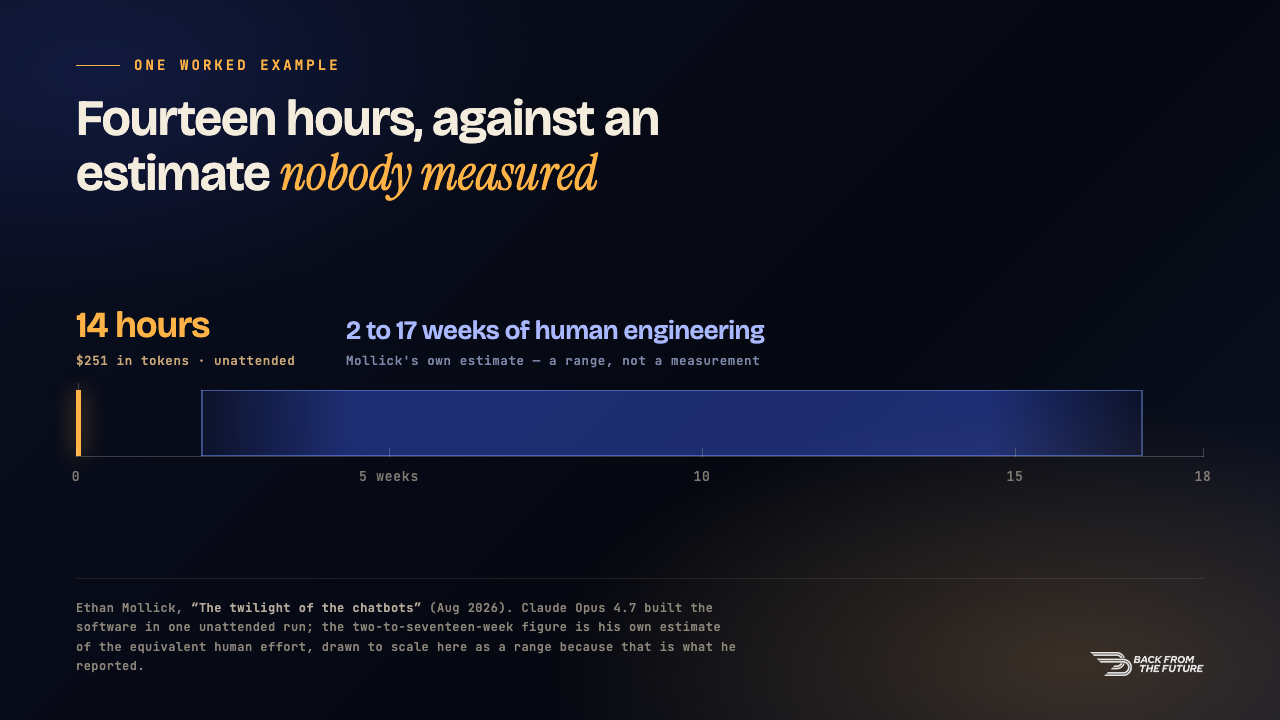
It sits alongside Ethan Mollick's essay from the same week, "The twilight of the chatbots," which arrives at the identical shift from the other direction. His worked example: Opus 4.7 spent fourteen hours building software he estimates would have taken two to seventeen weeks of human engineering, at a cost of $251 in tokens. That range is his estimate rather than a measurement, and he says so plainly. Nobody sat in a chat window while it happened.
For years we measured coding AI in tasks: fix this bug, write this function, pass this test. The scoped task was the atom of software work, and I think most people missed that it was quietly doing a second job at the same time. It was the first rung. It was the small, low-stakes, learn-by-doing piece of work you handed someone new, not because you needed it done cheaply, but because doing it was how they built judgment. Working inside a system. Reading what mattered. Knowing when something smelled wrong.
When the atom moves from task to product, that rung does not get harder to climb. It stops existing.
I do not have a clean answer to where formation happens instead, and I am suspicious of anyone who says they do this early. Apprenticeship is one of those institutions that is invisible until it is gone. What I notice, in the challenges we run, is that the organisations still producing capable mid-level people are the ones who kept some deliberately inefficient work in the building. That is a pattern from a handful of companies, not a finding, so treat it as a hypothesis I am watching rather than advice.
The dial was never on the model's capability. It was on where judgment gets built, and that is not a thing anyone is currently measuring.
Physical work is becoming a line on a calendar
A drone can now be scheduled to survey a site the way you schedule a database backup to run at 2am. Semi-autonomous, so a person still sets the route and watches the feed. But the trigger moved. You do not dispatch it each time. You define a recurring job and it flies.
Two other things from the week sit underneath that and make it possible. Formlabs shipped Flexible 80A Resin V2, a rubber-like material that returns to shape after repeated abuse, printed overnight on a desktop machine — which means a gripper stops being a tooling decision with a six-week lead time and becomes something you iterate on daily. And Robostral Navigate posted an 80.8% oracle success rate with 3.25% navigation error, beating the general-purpose models it was tested against at the one skill every warehouse picker needs solved before its hands ever matter.
None of those three is a headline on its own. Together they are the boring prerequisites for the same thing: physical work that runs on a schedule rather than on a dispatch.
For years we counted automation in robots. One machine, one task, one place. The more honest unit is the recurring job. Inspection every night, security sweep every hour, roof check every Monday. And I think that unit is what makes this transition politically strange, because a recurring job does not disappear in one dramatic announcement. It fades one shift at a time, and there is never a day when anyone can point at what happened.
The dial was never on the robot. It was on the scheduler.
Two roads into the enterprise, and neither runs through the benchmark
Anthropic announced a deal with Accenture that formally trains around 30,000 people on Claude and puts Claude Code in front of tens of thousands of developers, inside a three-year joint group aimed first at regulated industries (TechCrunch and Yahoo Finance, December 2025). I have seen the number 700,000 attached to this, which is Accenture's total headcount rather than the deal's scope, and the difference matters.
Whatever the scope, the mechanism is what I would pay attention to. Enterprise AI was supposed to be settled on model quality, and the companies that need it most do not buy models. They hire someone to tell them what to buy, and that someone arrives with a transformation project already on the roadmap. So the model does not show up as a login or an API key. It shows up wearing a badge.
Now watch the same week push in the opposite direction. MiniMax M3, an open-weight model quantised to Q4, ran locally on a single Mac Studio under someone's desk, read a photograph of a driver's licence, and filled out a US customs form correctly. No cloud, no metered API, no data leaving the building. For the enormous volume of regulated back-office paperwork where those three constraints are the whole problem, free-and-local wins before frontier-and-metered gets a hearing.
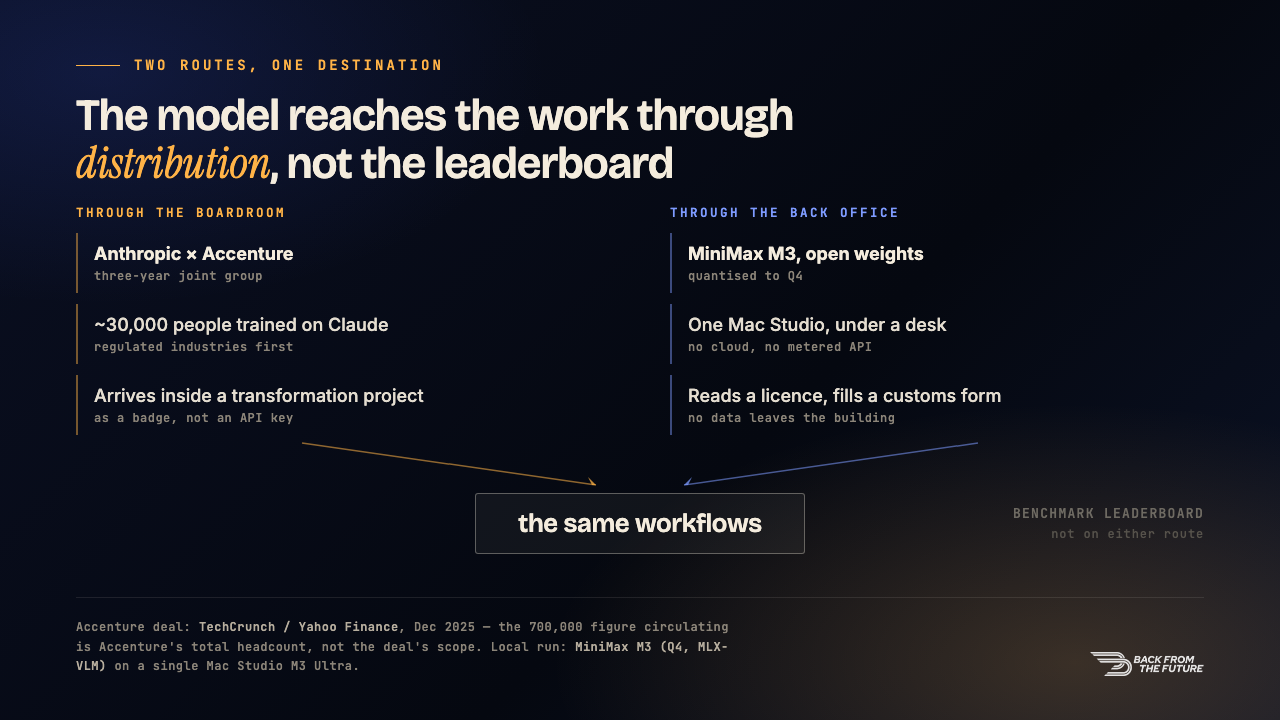
I would not read this as a story about which model is better, because on that question the two are not close. It is a story about two different doors into the same building, one through the boardroom and one through the back office, while the benchmark leaderboard everyone reads sits in the lobby.
The dial was never on model quality. It was on distribution.
A gene you can switch off from outside the skin
This is the one I have not stopped thinking about, and it is the furthest from my usual territory, so weigh my read accordingly.
A group in Korea published a mechanism in Cell. A protein called Cyb5b responds to a 60 hertz electromagnetic field, the frequency of mains electricity. It reads that rhythm, calcium begins oscillating inside the cell, and a second protein carries the signal along to a target gene and switches it on. Install the switch with a gene therapy vector, stand the animal between two coils, and you decide when the gene runs. Three days on, four days off. Nothing implanted, nothing swallowed.

They pointed it at ageing, which is the part that will get the coverage. Oct4, Sox2 and Klf4 under the switch, cycled in old mice and in mice bred to age early. Ageing markers reversed across several tissues and the animals lived longer.
Mice. Only mice, so far. The distance between a mouse result and a human therapy is where most of these stories quietly end, and I would put the odds of this specific protocol reaching people roughly where you would put any promising Cell paper, which is to say low and slow.
But the ageing result is not what makes this interesting to me. Gene therapy has always had a timing problem: once the payload is in, it runs on its own schedule, and your only real decision was whether to start. This turns the schedule into a dial you can reach from outside the body. Something you can switch off is a categorically different kind of medicine from something you take, in the way that a light switch is different from a candle.
The dial was never on the payload. For the first time it is on the outside, in someone's hand, which raises a question about whose hand that ought to be.
What the Control Surface is for
Five stories, one move. In each one, the loud argument was about a capability — better interceptors, better models, better robots, better therapies — and the thing that actually decided the outcome had already relocated to a cost ratio, a scheduler, a sales channel, an apprenticeship structure, an external dial.
I find this useful because it is a question you can ask on a Tuesday about something in your own organisation. When a new capability lands on your desk, the instinct is to evaluate the capability. The more revealing question is where the control surface for it now sits, and whether it is still attached to anyone with the authority to turn it.
I will be watching for whether this holds up over a few more weeks or whether I have found a pattern by squinting. Both are possible. Next week I will run the same question over whatever the week produces and see whether it survives contact.
Seven things I could not fit
The proof nobody can read. Dwarkesh Patel asked Grant Sanderson what happens when an AI proves the Riemann hypothesis and no mathematician can follow the argument. A verified proof nobody understands still counts as a proof. Whether it counts as understanding is the question every field is about to inherit, and mathematics is just where you can watch it happen in the open.
Police can draw a circle on a map. The geofence-warrant case before the Supreme Court traces back to a 2019 bank robbery outside Richmond; oral arguments were heard in April with a ruling expected this summer. The Knight First Amendment Institute, the Reporters Committee and the Brennan Center have all filed amicus briefs, which tells you they read it as a speech case rather than only a privacy one. The same circle that finds a robber finds everyone who attended a protest.
China's frontier model has a forecast date. The Substrate puts a Mythos-class Chinese model at around February 2027, which turns a vague "are they behind" argument into a countdown. Alongside an arXiv analysis arguing that US export policy accelerated China's open-model ecosystem rather than slowing it down, it makes for uncomfortable reading in Washington.
$310M for worlds you can walk through. Odyssey raised at a $1.5B valuation to build interactive world models: environments you move around inside in real time. Video gives you a scene to watch. A world lets you change it and see what happens, which is also what robots need to train in.
Thirty seconds of native 4K in one pass. Seedance 2.5 generates it in a single generation rather than stitched clips, takes up to 50 multimodal references, and accepts 3D blockout input. It ships to a consumer product, which is the threshold that matters — a capability inside a demo leaves your production pipeline theoretical.
Seeing through walls is becoming a library. IronSight turns ordinary 2D video from a single camera into a live 4D reconstruction where people and objects stay tracked, including behind solid walls. The repository is going open source this month. Free infrastructure has a way of finding uses nobody planned for it.
What people download versus what they admit to. Pew asked US adults in February what they use chatbots for: 42% said search, 38% work, 4% companionship. MiniMax's Talkie, a companionship app, is meanwhile climbing the US charts. When the download numbers and the survey numbers disagree that sharply, I would trust the downloads.
This is the connected version of the week. If it is useful, it lands in your feed every Monday.

Ruben Horbach
Co-founder · Back From the Future
Ruben researches how organisations adopt AI meaningfully — not as technology, but as a change in work and people. He builds the agent infrastructure behind BFF and speaks about the near future of work.