
In short
- For the first year on record, US wind and solar generated more electricity than coal.
- An OpenAI model disproved an 80-year-old Erdős math conjecture by finding a new construction.
- Figure's F.03 humanoid is working on BMW's actual Spartanburg production line.
- By 2028, AI will want ~4.8x the power North America can add in new grid capacity.
- AI that removes the struggle deskills; AI that scaffolds it doesn't.
Every week a dozen developments break and none of them make sense alone. A grid number here, a robot demo there, a paper, a bond sale, a Slack handle. Taken separately they are noise, and I spend most of my week reading them separately, which is why I write this: the pattern only shows up when I put them side by side.
This week the through-line is a threshold. Across energy, robotics and AI, a set of things that had been living in the future tense moved quietly into the present. The interesting part is not that they arrived. It is that what feeds them did not arrive with them.
Five stories on that, and then six things I could not fit.
Renewables stopped being the supplement
For the first year on record, US wind and solar generated more electricity than coal, according to the annual generation figures. Coal built the American grid and ran as the default source for a century, and in 2025 it slipped behind two sources that barely registered fifteen years ago.
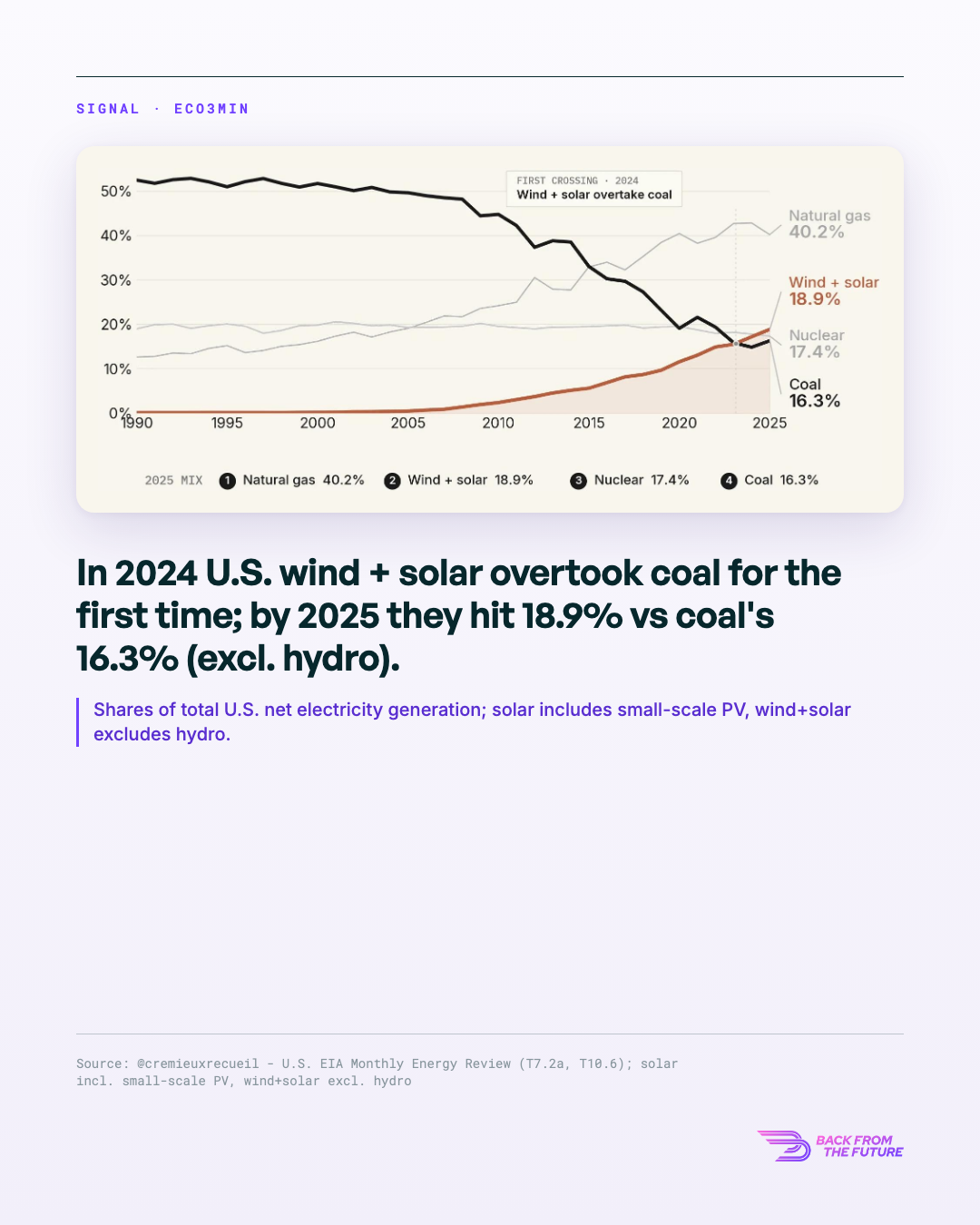
The same shift shows up across the Atlantic, and there the mechanism is easier to see. Ember reports that British power prices are increasingly decoupling from gas. For decades the gas price effectively set the electricity price, because a gas plant was usually the last one dispatched and the last plant on the margin sets the clearing price for everybody. As wind and solar carry more of the load, gas sits on the margin less often, and the link that made your electricity bill a bet on a commodity market starts to loosen.
I would not read this as the transition being finished. Generation share is the easy half. The hard half is the hours when neither source is producing, which is exactly when gas comes back onto the margin and sets the price again, and an annual average hides every one of those hours. What the crossing does tell you is that the argument has changed shape. We keep discussing the energy transition as a forecast, and this week it read as a scoreboard.
Capability crosses into the present while the things that feed it are still running on old timelines.
The humanoid stack is maturing one subsystem at a time
I have been watching the robotics demos for a while now, and the same story keeps telling itself in parts. Wuji Tech's Hand 2 moves metal fingers with something close to the speed and precision of a human hand. Unitree's G1 takes a spoken command in plain language and turns it into physical action in real time. Dexterity here, speech-to-action there, locomotion already solved elsewhere. The pieces are showing up separately, on different bodies, from teams that do not work together.
Then there is the piece nobody sells. NRE-Skin is a neuromorphic electronic skin that copies the human reflex arc. When you touch a hot surface your hand pulls back before your brain has decided anything; the skin senses contact, damage or heat and fires a reaction locally, without waiting for a central model. Every humanoid demo I see sells you the legs and the hands. Skin is the sensor surface that decides whether a robot is safe to stand next to, and I would watch it more closely than the backflips.
The scoreboard has quietly changed too. Figure's F.03 humanoid is standing on the line at BMW's plant in Spartanburg. Not a rendered demo, not a staged warehouse: BMW's biggest US plant, a named customer, a robot on the actual floor.
For years the question was whether it could walk. Now it is who pays for one to work a shift, and that bar means uptime, safety around people, a task that survives a full production day, and a cost a plant manager can defend to his own boss. It is worth being precise about what a placement like this proves, though. A robot on a line is not the same as a robot carrying a line, and BMW has not published what share of the work it does or how often a human intervenes. Pilots on famous factory floors are also, historically, the easiest thing in this industry to arrange and the hardest thing to read.
AI crossed from answering our questions to producing new ones
An OpenAI model apparently disproved a math conjecture that had stood for eighty years. The question goes back to Paul Erdős in 1946, about how points can be arranged in a plane; for decades the best constructions looked like tidy square grids and most people assumed that was the ceiling. The model found a different family that beats it.
Here is what separates this from the usual benchmark headline. Until now these systems climbed tests we designed, answering questions we already had answers to. This time a model worked on a prominent open problem at the centre of a field and produced a construction nobody had written down.
That reframes what the field even is. Microsoft's chief scientist Eric Horvitz says he never liked the term artificial intelligence and prefers computational intelligence, because in his view the same class of process describes a biological nervous system and a machine. If he is right, the map rearranges: the wins we remember from this decade may not come from chatbots and code at all. Horvitz expects them in biology and medicine, filed under AI.
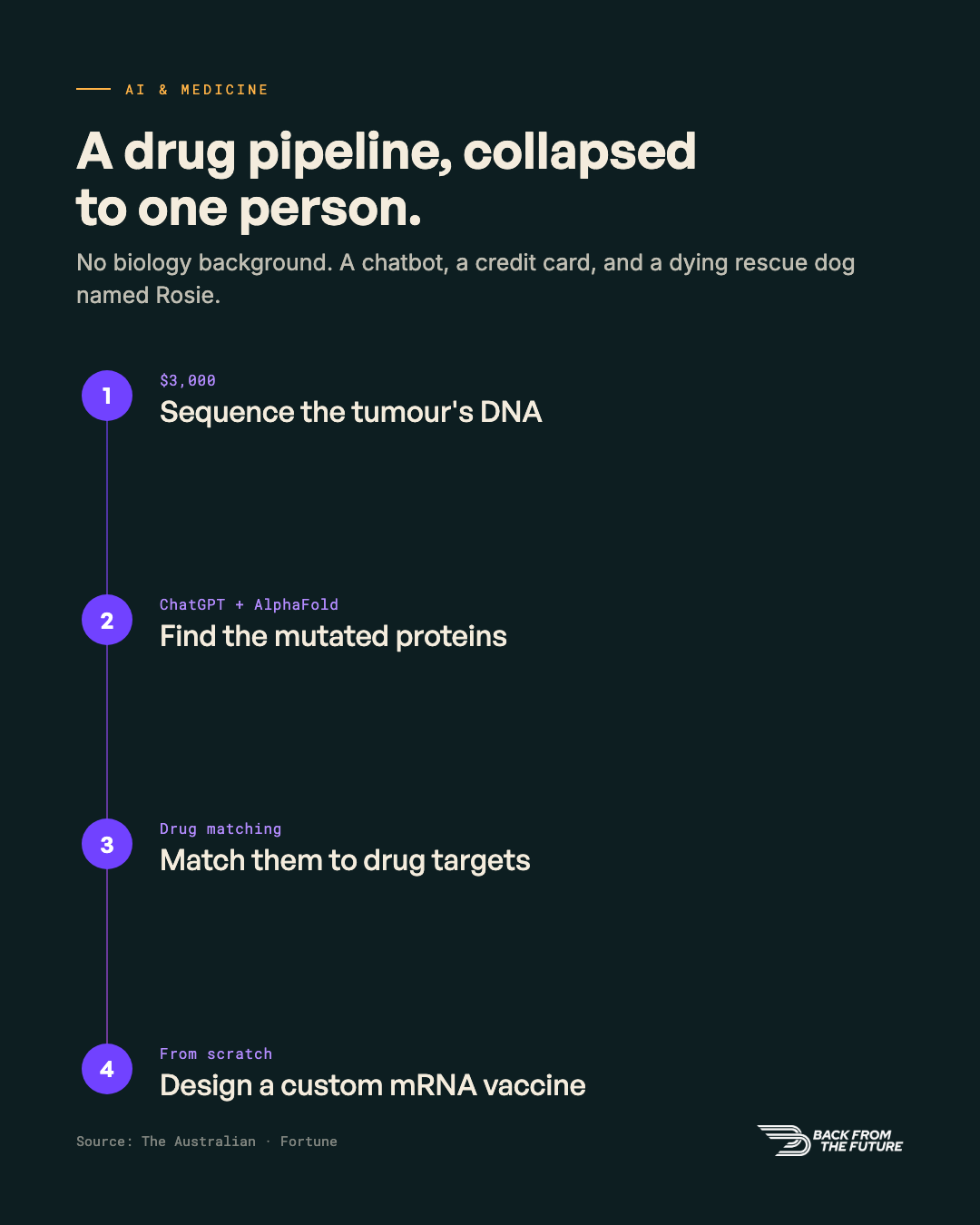
Someone already ran that experiment without meaning to. A tech entrepreneur in Australia with no biology background sequenced his dying rescue dog's tumour for about $1,000, ran the DNA through ChatGPT and AlphaFold to find the mutated proteins, and designed a personalised mRNA vaccine from scratch. The genomics professor who reviewed it was, in his own word, gobsmacked. One tumour has since roughly halved, which is not the same as a cure, and the reporting is careful about that. The dog is not cured and the vaccine has not been shown to be the cause. What changed is the distance between a hard problem and one person willing to attack it.
Cheap competence stretches demand
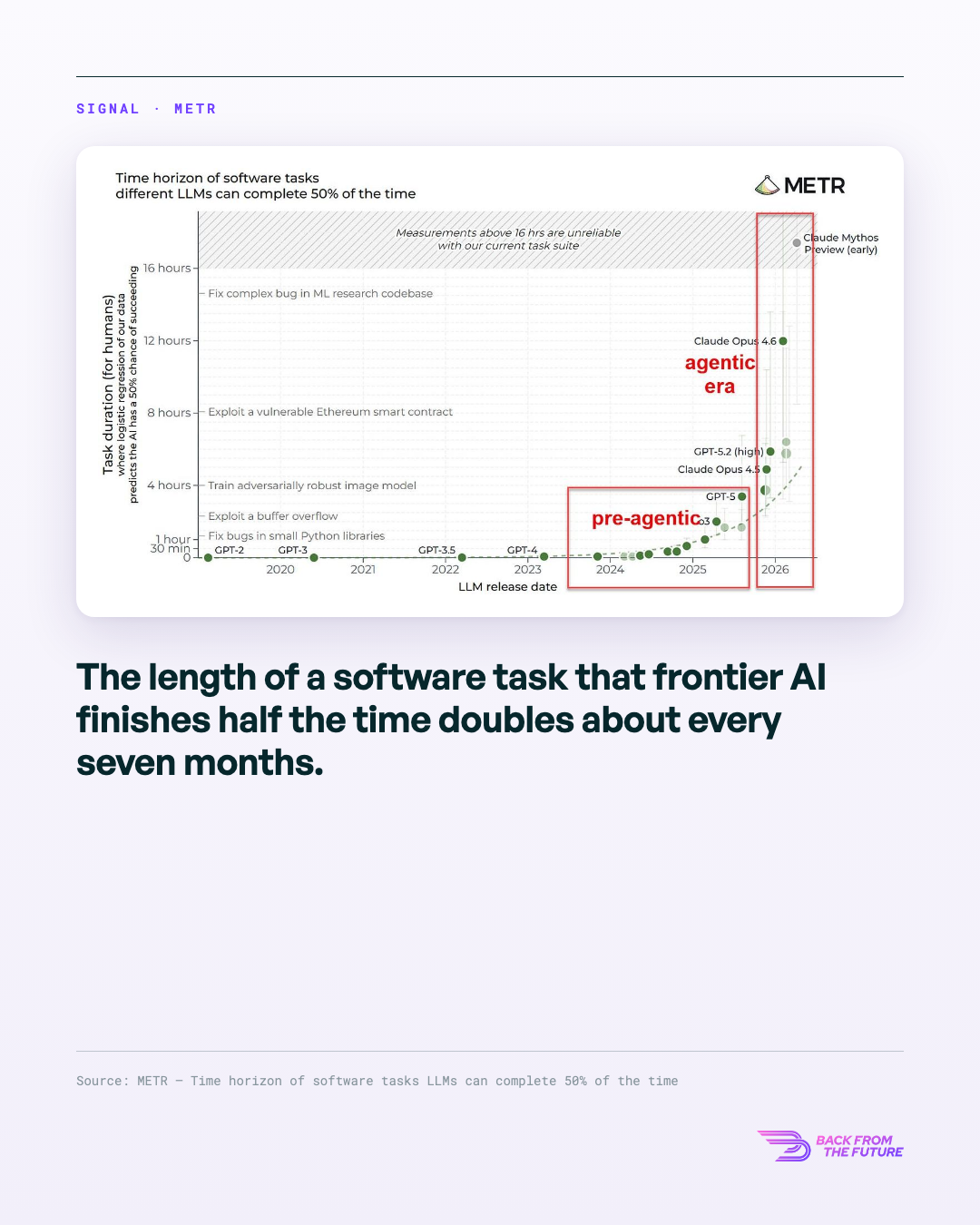
METR tracks how long a software task frontier models can finish at least half the time. In the GPT-4 era that was a few minutes; today it is multi-hour work, and METR estimates the curve doubles roughly every 7 months. Dwarkesh Patel points at the cap on the next leap, which is continual learning: a model starts every session from zero, while a new hire is slow in month one and carries context by month six. Once models keep what they learn on the job, the whole measure changes.
The headcount arithmetic is the part I see most plans get wrong. Dan Shipper automated every task he could with AI agents and his company grew from 4 people to 30, which sounds like a paradox until you look at what the agents freed up. Every workflow handed over released people into work they could not reach before, so the human work grew.
I would hold that one loosely. It is a single company, a media company, and one where the founder's incentive to tell this particular story is not small. But it matches what we see in the challenges: when expert competence gets cheap you find more places to put experts. Cheaper legal review means more contracts reviewed. Cheaper analysis means more questions asked. Most plans budget for headcount coming out. The teams pulling ahead budget for what to do with the room that opens up, which is a harder thing to put in a business case because the return arrives as work nobody was doing before.
The feed gap
Every threshold this week hides a bottleneck, and they rhyme enough that I have started calling the pattern the feed gap: capability crosses into the present while the things that feed it are still running on old timelines.
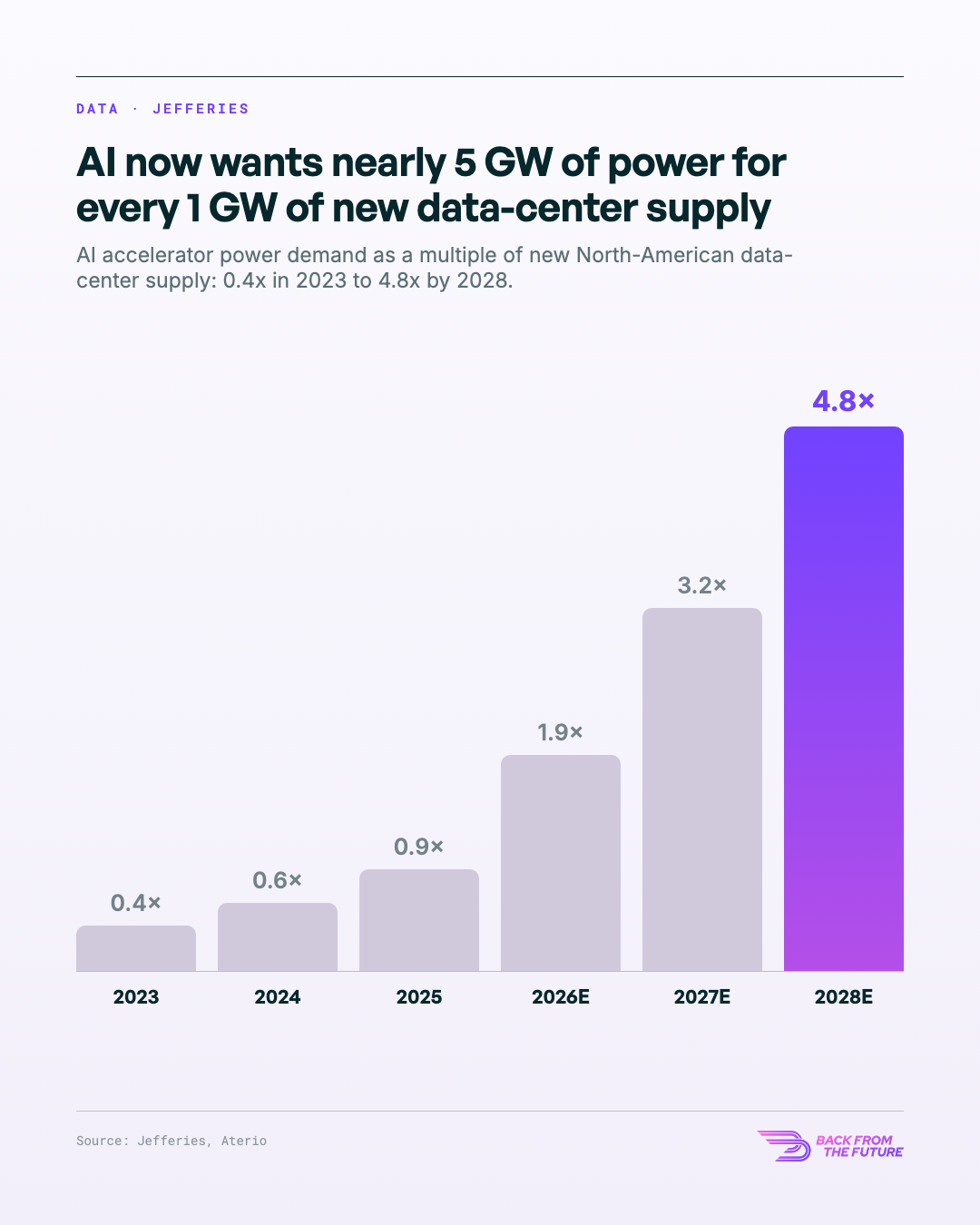
Power is the clearest case. By 2028, on the projections I have seen, AI will probably want close to five gigawatts for every gigawatt of new data centre capacity North America can build. In 2023 that ratio was 0.4x and supply comfortably covered demand; by 2028 the chart puts it at 4.8x. I find it hard to look away from, because a ratio moving from 0.4 to nearly 5 in five years is not a forecast anyone can build their way out of. Everyone tracks compute doubling and almost nobody tracks whether the grid can feed it. Silicon scales in a couple of years. A high-voltage transformer has a multi-year lead time, a substation needs permits, and transmission lines need land and a decade of patience.
One more feed, and this one is human. Nature Medicine has a name for what AI may be doing to medical training: never-skilling. We have worried about de-skilling, the surgeon or coder whose edge dulls from leaning on the machine. Never-skilling is quieter, because a trainee who reads every scan alongside an AI from day one may never build the internal model to read one without it.
A large study in China appears to have found the mechanism. As students used AI to cut homework time, the researchers report their scores dropped in lockstep. AI that removes the struggle deskills; AI that scaffolds the struggle does not. Same tool, opposite outcome, and what predicts which one you get is whether the effort survives contact with it. That is a study of students rather than of professionals, so I would not port the finding wholesale into a hospital. The mechanism is general enough to be worth testing wherever you are training anyone.
The close
Stringing the week together, one shape emerges. Renewables set the price. A model produced new math. A robot clocked in at BMW. A dog got better. Each on its own is a headline; together they mark the same crossing, from something coming to something here.
So the interesting question is no longer whether the capability arrives, because this week says it already has, in pieces. The question is the feed gap: the grid, the transformers, the tungsten, and the people who still have to learn the work before the machine does it for them. If you are planning anything for next year, that is the side of the ledger I would spend your attention on, because the capability will show up whether you prepare for it or not and the feed will not.
Six things I could not fit
The robot jobs arriving first are the ones we cannot do. DEEP Robotics' Pulse is a firefighting dog that walks into burning buildings and suppresses the fire while people stay back, remotely operated and with no lungs to fill with smoke. REACCH was tested aboard the ISS to capture defunct satellites before one piece of junk becomes a thousand. Neither is aimed at a factory. Fire, vacuum and debris at orbital speed are where the economics work first, because there is no human alternative to price against.
Claude got a Slack handle. Anthropic's Claude Tag drops the model into Slack as a team member: it sits in the channels you choose, gets tagged like a colleague, and picks up delegated tasks in the same threads as your humans. Using AI used to mean leaving — open a tab, type, copy the answer back. One engineer described the shift as making the model inline with everything else, and that word is doing more work than it looks.
The buildout is running on debt now. Twice in four months Amazon went to the bond market to fund its AI expansion: $37 billion in March across eleven tranches, and reportedly at least $25 billion more this month. In the same stretch Meta started a cloud business to rent out its excess compute. For years the capex came from pocket money; now one side is issuing debt for the next wave and the other is monetising the GPUs it already owns.
Tungsten went vertical. The price sat below $0.5K per DMTU for over a decade and then climbed at an angle that looks nothing like the flat line before it. Tungsten is the quiet input behind armour-piercing rounds, machine-tool cutting edges and semiconductor contacts — twice as dense as steel, melting at 3,400°C, which is why you cannot substitute it. China controls the majority of supply. Everyone watches chips and rare earths; this is what a critical-materials squeeze looks like once it reaches a market.
You can now walk through a Gaussian splat. SuperSplat added voxel collision, turning a splat into accurate 5cm voxels automatically, with physics solid enough to stand on and far lighter to render than a mesh. For three years these captures were a rendering trick: gorgeous, and untouchable. Collision is the difference between a photograph you can orbit and a place you can build in.
Five governments agreed on a deadline. The Five Eyes alliance published a joint statement telling organisations they have months, not years, to harden their systems against a cyber threat accelerating on frontier AI. When five governments coordinate on a timeline that short it stops reading as vendor marketing. It is the clearest official statement yet on where offence currently sits relative to defence.
This is the connected version of the week. If it is useful, it lands in your feed every Monday.

Ruben Horbach
Co-founder · Back From the Future
Ruben researches how organisations adopt AI meaningfully — not as technology, but as a change in work and people. He builds the agent infrastructure behind BFF and speaks about the near future of work.