

In short
- EBR-bench shows little evidence of AI learning from experience across repeated game attempts.
- Sovereignty lives in the stack — index, weights, chips, cloud — not in swapping the interface.
- Frontier research is simultaneously $100B expensive and achievable on a single consumer GPU.
- Only 3% of Unitree's shipped robots do useful work; LLMs are now supplying the missing interface layer.
- OpenAI's internal AI token use grew 53x since November, previewing agentic knowledge work.
Most of the AI news I read this week was fighting over the wrong layer. Who is winning, who is biggest, who missed the train. The more useful reading is vertical, and it comes down to one question I now ask of every headline: which layer down does this actually live on? The interface or the index. The demo or the deployment. The shipment forecast or the 3% that does real work.
Call it the layer question. I have found it does more work than any framework I picked up this year, mostly because it survives contact with a headline you know nothing about. Here are five stories where the surface reading and the layer-underneath reading point in different directions, and then five things I could not fit.
The benchmark that stopped testing memory
Almost every AI benchmark tests what a model already knows. Freeze an exam, score the model, publish the number. A high score means the model memorised the world as it was, which is useful and is not the thing you hire for.
Epoch released EBR-bench this week, and according to the lab it asks something else. It drops a model into Earthborne Rangers, a complex board game it has never seen. Then it measures whether the model improves across repeated attempts. Not recall, not a lucky one-shot, but the kind of getting-better that comes from playing and failing and adjusting. Epoch reports its own headline finding plainly: little evidence of AI learning from experience (Epoch AI, EBR-Bench results, July 2026).

That gap matters more than it sounds, because climbing a learning curve inside a fresh game is much closer to what we actually hire people for than acing a frozen test. One benchmark on one game is thin evidence and I would not build a thesis on it yet.
The fair objection is that this may be measuring the harness rather than the model. A system with no memory between attempts cannot improve across them by construction, and most deployed setups now carry some scaffolding that a bare benchmark run does not. So the honest version of the finding is narrower than the headline: models do not spontaneously learn from experience, and whether the scaffolding around them can substitute for that is a separate question nobody has answered cleanly. Either way the number worth watching is not the leaderboard score everyone quotes. It is whether the curve bends upward on the second attempt.
So the search box shows a French flag while the infrastructure underneath stays American. The procurement changed and the stack did not.
Sovereignty is a stack, not a logo
The European Parliament dropped Google to reduce its dependence on American tech and picked Qwant, a French search engine. According to Qwant's own documentation, it builds its results by querying Microsoft's Bing index. So the search box shows a French flag while the infrastructure underneath stays American. The procurement changed and the stack did not.
That is the shape of most sovereignty debates I sit in right now. We treat sovereignty as a vendor choice, a line in a tender, when it lives further down: who owns the index, the model weights, the chips, the cloud the whole thing runs on. Swap the interface and every one of those stays exactly where it was.
In fairness to the buyers, some of this is not naivety. A procurement team can change a vendor inside a budget cycle. It cannot conjure a European search index at all. The interface is the only layer it has authority over. That is a real constraint rather than an excuse, and it is precisely why the layer question belongs in the room before the decision instead of in the commentary afterwards.
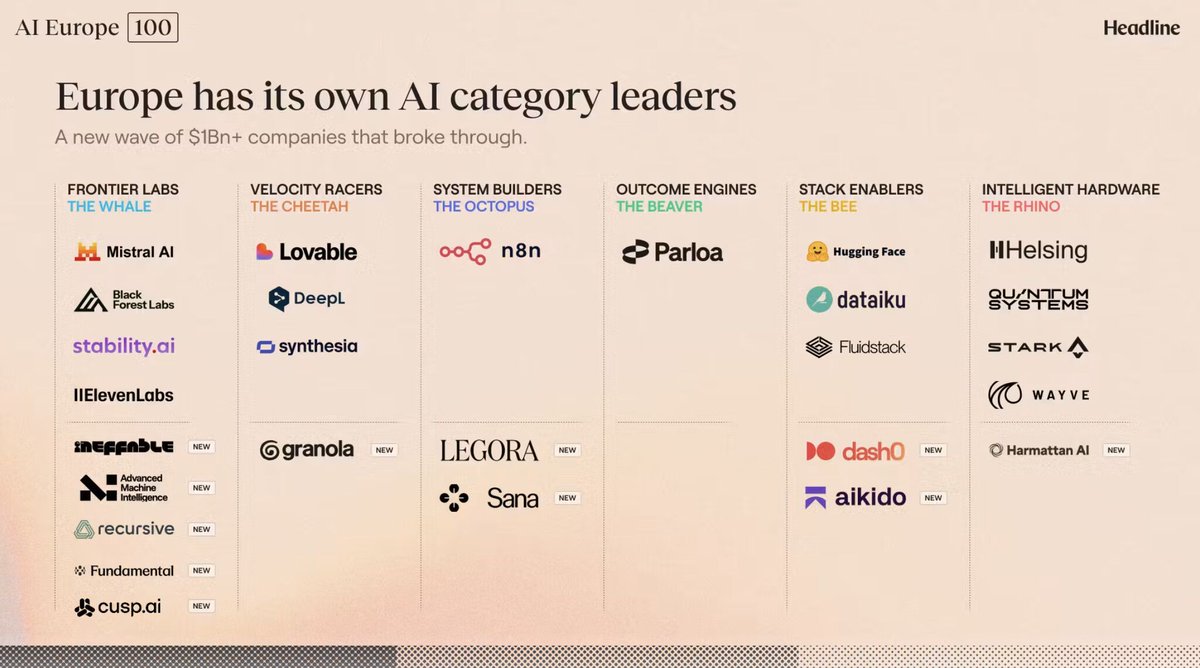
The same reframe rescues Europe from its own doom story. The narrative says Europe missed the AI train and has two years to catch up. Look at the map by layer and Europe has billion-dollar category leaders across six distinct layers of the stack, from infrastructure through tooling to application. What is genuinely thin is one layer, frontier models and the compute underneath them, and that is exactly where the dependence sits. If you are anywhere near a sovereign-tech decision this year, that is the question I would put on the table before the launch rather than after: which layer are we actually changing?
The floor dropped while the ceiling got more expensive
A new-grad software engineer at Walmart got an independent paper, InfiniteDiffusion, into SIGGRAPH 2026. One RTX 3090 Ti. No funding, no advisor, no lab, no team.
In the same week you were reading about multi-billion-dollar AI bond sales and gigawatt data centres, the floor for doing frontier-adjacent research quietly dropped to a single consumer GPU and enough stubbornness to keep going after work.
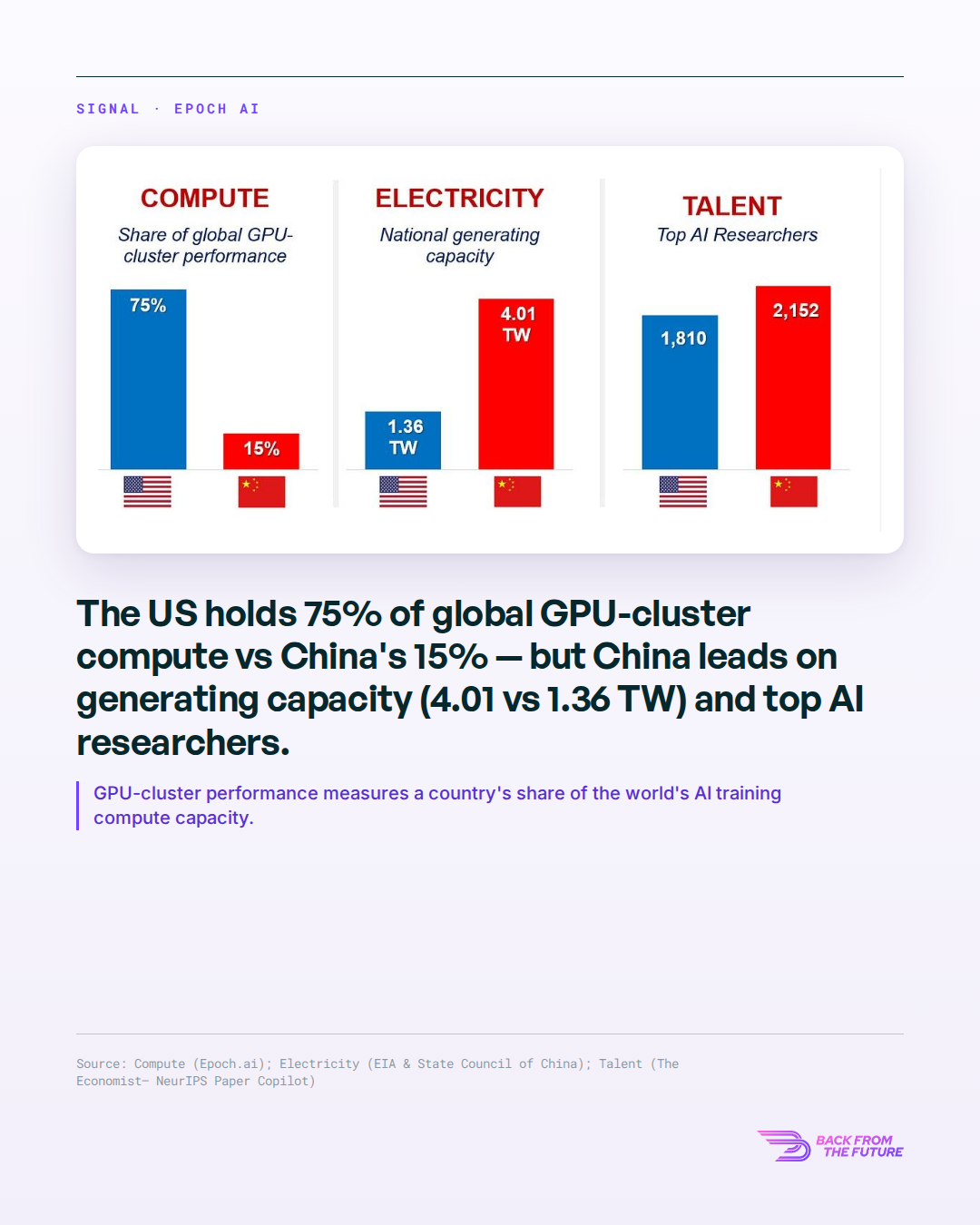
Both things are true at once, and that split runs through the whole week. On the estimates I have seen the US holds around 75% of the world's GPU-cluster compute against China's 15%, roughly a five-fold gap in raw training capacity that decides who trains the next frontier model first. Meanwhile Sakana AI's Fugu, built in Tokyo by a lab that made its name doing more with less compute, landed shoulder to shoulder with the top labs on the hardest reasoning benchmarks. And Micron signed $100B in long-term supply agreements while saying it has no idea when the RAM shortage ends, apparently because compute is doubling roughly every seven months and every layer underneath gets squeezed in sequence. First the accelerators, then the memory, then power.
I would hold the encouraging half of that lightly. One accepted paper is one accepted paper, and the fields where a single consumer GPU still reaches the frontier are the ones where the frontier is an idea rather than a training run. Nobody is reproducing a frontier model on a desktop card. What the cheap end genuinely buys is the ability to find a method nobody has tried, which is a different and narrower opportunity than "anyone can compete now".
Still, the expensive frontier belongs to a handful of labs and the interesting edges belong to whoever is willing to work the layer they can afford. For most people in a mid-sized company that is a more encouraging position than they assume they are in.
The number nobody in robotics wants to quote
Unitree shipped around 5,500 robots last year and, by its own reckoning, only 3% of them did any useful work. The rest went to research labs and entertainment: demos, stages, university corridors, not a single real job.
As a headline that sounds like failure. As a strategy it is the opposite, because you sell into buyers who do not need the robot to be economically useful yet, use their money to fund the learning curve, and move into industry once hardware and models are ready. I think that 3% is the most honest figure in humanoid robotics. Everyone quotes shipment forecasts to you and almost nobody quotes deployed usefulness.
The missing layer just clicked into place. Unitree's G1 went from spoken command to motion, with automatic speech recognition picking up natural language, the robot interpreting what you meant, and then acting. No teleoperation, no script, nobody holding a controller behind the curtain. The bodies got good years ago on balance and dexterity and perception. What was missing was the interface: a way for you to say what you wanted without touching a controller, and an LLM turns loose human speech into action.
The other axis moved too. PNDbotics' Adam, from a company I suspect most people have never heard of, climbed onto a box a metre high, which takes whole-body planning, weight shift, and the ability to catch itself when the math is slightly off. A year ago the bar was staying upright on flat ground. And Nori L2 is reported to open orders next week at roughly the price of a flagship phone. Once a technology hits phone pricing the question stops being whether it can work and becomes who buys ten thousand of them.
Capability, interface, price: the 3% is about to get its second and third factors. What it still does not have is the fourth, which is a job description. A robot that understands you and costs what a phone costs is still waiting on someone to define the task precisely enough to be worth paying for, and in my experience that definition takes longer inside an organisation than any of the engineering did.
AI's first customer is showing you the preview
According to internal data OpenAI released this week, its research team is now burning 53x more tokens than it did in November. That is not a product benchmark but a picture of how its own people work: longer-running, more complex, increasingly cross-functional tasks handed to Codex, with research at the top of the growth curve.
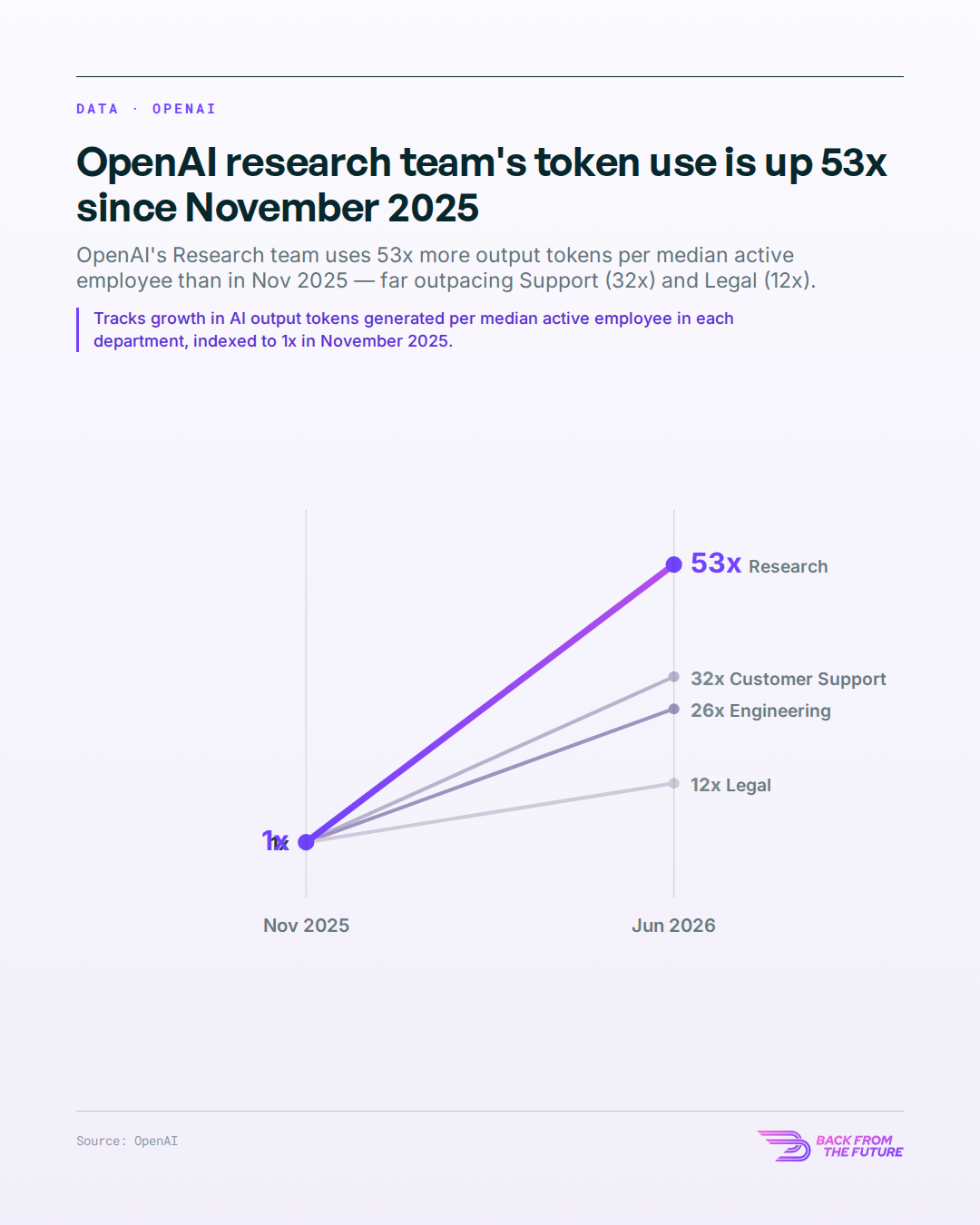
The frontier lab is its own first customer. So whatever agentic work looks like inside those walls today previews what lands in every knowledge-work company next. A canary, running a year or two ahead. The same week, an open experiment let more than a hundred AI agents coordinate on a shared task over days without a human steering each step. They divided labour, handed work off, built on each other's output, and roles emerged that nobody scripted. For two years the story was one agent getting better at one job. Coordination is the next phase, and it brings its own physics. Agents duplicate work. They talk past each other. One bad output propagates through the group before anyone catches it.
The human side of that shift is calmer than the headlines suggest. According to the survey data, most people are using this for search and for work, companionship sits at a mere 4%, and roughly a quarter of users are on it daily. The gender gap everyone assumed was structural has nearly closed: two years ago it was 28% of women against 39% of men, and today those lines sit within a few points of each other.
The finding I keep returning to is the last one. The group most worried about where this goes skews youngest — 48% of 18-to-29 year-olds expect negative outcomes, more than any older bracket. So the heaviest and most fluent users appear to carry the deepest unease. I would be careful about reading causation into that, since the same age group is also the one competing for entry-level work, but if you are about to run an adoption programme aimed at your enthusiasts it is probably worth sitting with.
The layer to watch here is not the model. It is the organisation around the people already using it daily. A quarter of your team has folded this into their routine, and the open question is whether the organisation has noticed. That is exactly why I keep coming back to shared understanding in my keynotes, because you cannot coordinate a tool nobody has mapped yet.
The forward read
Every story this week rewards the same move, which is to leave the surface alone and ask which layer underneath actually changed. A French flag on a Bing index. A phone-priced body that was missing its interface until an LLM supplied it. A benchmark score that cannot climb a fresh learning curve. A frontier that is simultaneously $100B expensive and one-GPU cheap.
The reason the layer question keeps paying is that surfaces are designed and layers are not. An interface is chosen by someone who wants you to read it a particular way, whereas an index, a supply agreement or a token meter exists for reasons that have nothing to do with how the story lands. Next week the fights will look different and the method will be identical.
Five things I could not fit
A full 3D human from one photograph. Meta's SAM 3D Body turns a single RGB image into a complete body mesh, either automatically or guided with masks, and it is a CVPR 2026 award candidate. In the same week a separate image-to-3D generator crossed 10 million polygons from one photo, fine enough to resolve skin microstructure. Single-image 3D used to mean a rough approximation you would spend hours fixing by hand; it is now clean enough to drop straight into a pipeline.
Generated video with real coordinates. Google wired its generative video model into Street View, so agents in Google Flow can produce images and video grounded in an actual location. Point it at a corner in Lisbon and the scene carries that corner's real geometry. Most generative video looks plausible everywhere and true nowhere, which is exactly the weakness a photographic index of the planet is built to fix.
The heaviest AI adopters are hiring. High-intensity adopters grew headcount by 10.2% in the 24 months after adoption, which runs against the default story where AI arrives and jobs vanish. The mechanism is unglamorous: when a unit of work gets cheaper, ambition tends to expand into the gap rather than the savings being banked. One dataset, and the direction is the opposite of the one most boards are planning around.
More dementia cases, lower dementia risk. Line up birth cohorts at the same age and each newer one sits lower than the last, so age-specific risk has been falling for decades. The total case count will still climb, because there are more old people. Both are true simultaneously, which is why the population headline and the personal number point in opposite directions.
Fifty drones at once, as standing doctrine. South Korea's air force is running live drills against a coordinated swarm of 50. For most of the past decade swarms lived in research papers, so a national air force building interception exercises around them is the tell that they have crossed into doctrine. Ukraine is on track to build around 7 million drones this year; that was the offence story, and this is the harder half of it.
This is the connected version of the week. If it is useful, it lands in your feed every Monday.

Ruben Horbach
Co-founder · Back From the Future
Ruben researches how organisations adopt AI meaningfully — not as technology, but as a change in work and people. He builds the agent infrastructure behind BFF and speaks about the near future of work.