
In short
- Tsinghua's DISH method cures an entire resin object in 0.6 seconds by projecting patterned light into a vat.
- It decouples fabrication time from object size, breaking the core assumption behind additive manufacturing.
- Sub-second curing collapses the physical design-iteration loop to near-digital speed.
- On-demand manufacturing's bottleneck shifts from print time to logistics and materials.
- Still limited to small resin parts, but high-value categories like dental and medical devices matter first.
A 3D printer at Tsinghua University formed a complete object in 0.6 seconds. The method, called DISH, projects patterned light into a vat of resin and cures the whole shape at once, so the object appears in the liquid fully formed, like something surfacing.
I posted about this last week and it travelled further than most things I share. I think I know why. The demo is striking, but what makes it stick is that it quietly breaks a mental model we have carried for forty years.
The vertical axis was never a law of nature
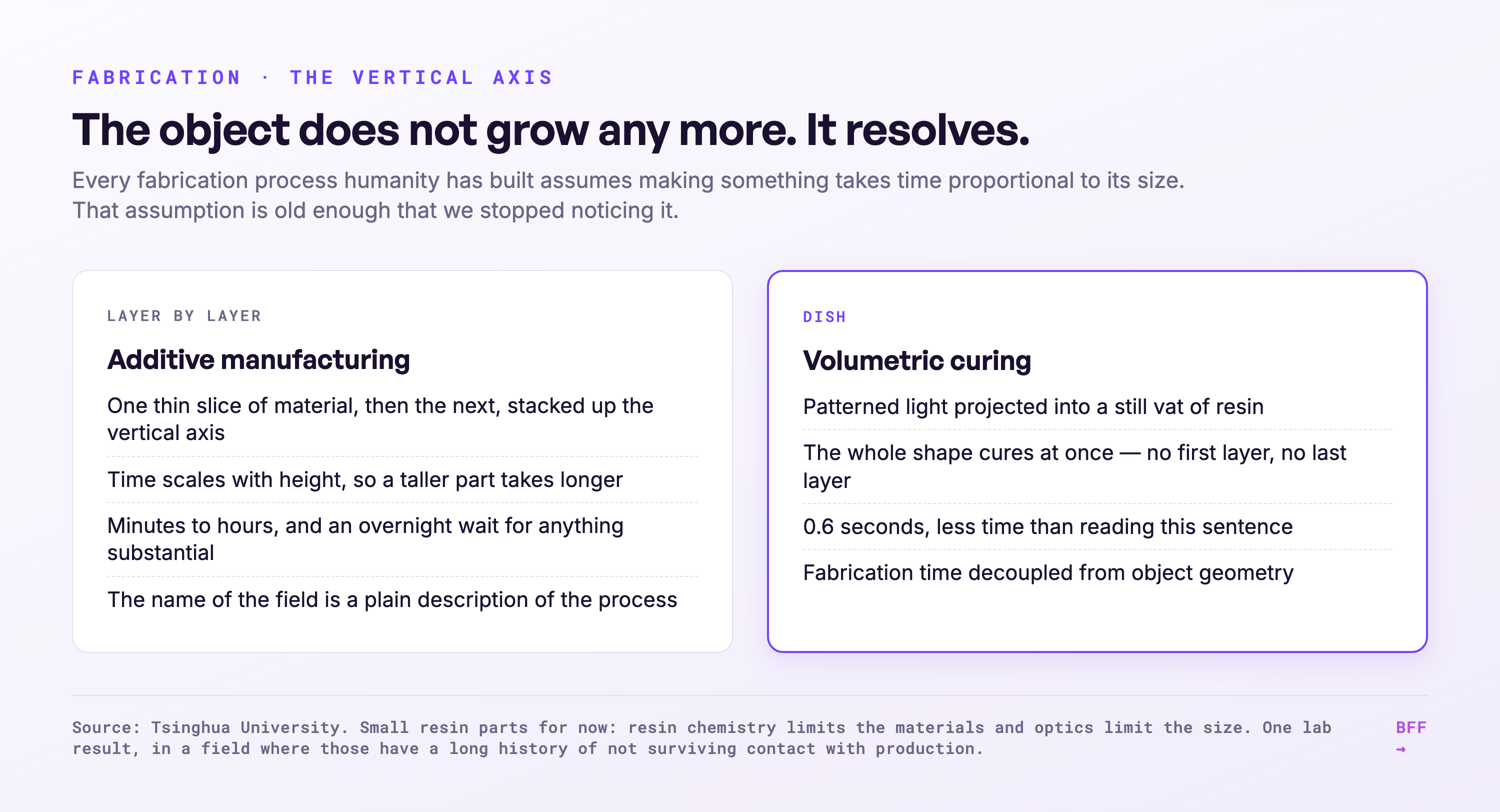
Every conventional 3D printer works the same way underneath: one thin slice of material, then the next, then the next, stacked up the vertical axis for minutes or hours. That is why we called the whole field additive manufacturing. You add material over time, and the time scales with height, so a taller part takes longer. Anyone who has waited overnight for a print knows this in their bones.
DISH removes that axis. There is no first layer and no last layer, because the light pattern defines the entire volume simultaneously and the object resolves rather than grows.
The field has been circling this for a while. Non-planar printing with 6-axis motion systems already broke the assumption that layers must be flat, letting the print head move around the object rather than only up it, and tomographic and volumetric approaches have been pushing toward curing in bulk. DISH looks like the moment that trend line touches its logical endpoint: fabrication time decoupled from object geometry, at least for small resin parts.
The object doesn't grow anymore. It resolves. The organizations built around waiting will need to resolve too.
Why the mental model matters more than the demo
Here is the frame I keep coming back to. Every fabrication process humanity has ever built assumes that making something takes time proportional to its size. Carving, casting, machining, printing. Bigger thing, more time. The assumption is so old that we stopped noticing it, and it is baked into how factories are laid out, how supply chains buffer inventory, how designers think about iteration, and how economists model production.
Take the assumption away and a lot of downstream logic gets shaky.
Start with iteration speed. The design loop for physical objects has always been throttled by the make step, and on the digital side that throttle is already gone: Tencent's Hunyuan3D 2.0 family cut model generation from 30 seconds to 1 second, and hobbyists are already running full pipelines from AI-generated concept to STL file to printed object in minutes. The physical print was the slow link in that chain. If curing takes under a second, the loop from idea to object in your hand starts to resemble the loop from idea to image on your screen. A designer who grew up treating physical prototypes as precious will work very differently from one who can burn through fifty in a morning.
Then supply chains. On-demand manufacturing has always carried an asterisk: on demand, plus print time, plus post-processing, plus the operator cycle of removing the part and starting the next one. Print farms are already automating that last piece with robots that clear beds and restart jobs. Compress the print itself to sub-second and the bottleneck migrates entirely to logistics and materials, at which point "we will make it when you order it" stops being a compromise and becomes the default.
The honest caveats
Right now this is small parts in resin. Resin chemistry limits the materials and optics limit the size, so nobody is materialising an engine block. The 7.7-metre concrete arch Zaha Hadid Architects printed recently still went down the old way, layer by layer, because concrete at architectural scale is a different physics problem entirely. This is also one lab result, and lab results have a long history of not surviving contact with production.
The question I find more useful than whether something can do everything today is which assumption it just falsified. Photolithography started as a niche trick for patterning small things and ended up defining the entire economics of computing. Instant volumetric fabrication does not need to scale to buildings to matter. It needs to scale to the parts categories where speed changes the business: dental, hearing aids, medical devices, custom components. Researchers in South Korea have already 3D-printed an artificial cornea, and it is worth sitting with what that class of patient-specific part looks like when it takes less time than reading this sentence.
Where this points
For decades, printing a physical object meant assembling it over time, and the word additive was a plain description of the process. DISH suggests the process was an implementation detail and the description will not survive it.
When a constraint that old disappears, the second-order effects take years to arrive and they arrive somewhere nobody predicted. So if you design or build or ship physical products, here is the exercise I would run this month: walk your own workflow and mark every step that exists purely because making things takes time. Buffers. Batch sizes. Prototype budgets. Lead-time clauses.
Every one of those marks is a place where this technology, once it matures, rewrites your rules. The object does not grow anymore. It resolves. The organisations built around waiting will have to resolve too.

Ruben Horbach
Co-founder · Back From the Future
Ruben researches how organisations adopt AI meaningfully — not as technology, but as a change in work and people. He builds the agent infrastructure behind BFF and speaks about the near future of work.