
In short
- Hybrid wheel-leg robots are converging as an engineering consensus across six independent platforms in about a year.
- Agriculture proves Work-Shaped Design: morphology follows terrain, not the human form.
- The real breakthrough is autonomous mode-switching — the robot reads the ground and reconfigures itself.
- The humanoid compatibility argument holds indoors but evaporates in unbuilt environments.
- Leaders should ask where their terrain breaks: fast modes for flat rows, careful modes for the ditches.
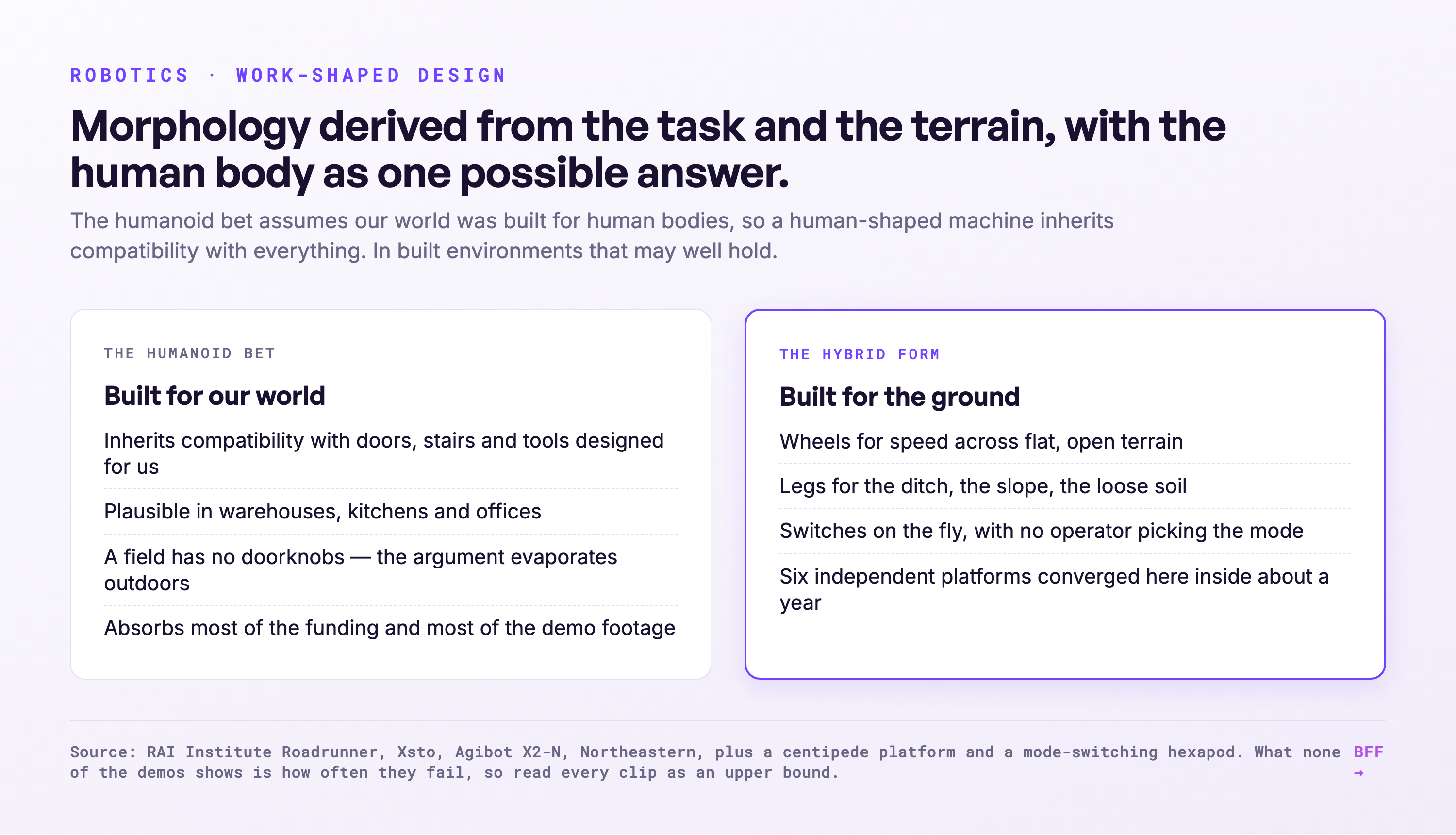
A post I wrote in June about a field robot did something my robotics posts rarely do: it travelled well beyond my usual audience. The robot in the clip drives when the ground is flat and walks when the ground breaks. Wheels for speed across open terrain, legs for the ditch, the slope, the loose soil. It switches on the fly, without an operator picking the mode.
I think the reach says something. People are quietly tired of the humanoid conversation, and this machine offered a different answer to the question everyone's been circling: what should a robot actually look like?
The pattern in my own archive
When I went back through my research notes, I found the same design move appearing everywhere, across labs and continents, over roughly a year.
The RAI Institute's Roadrunner, which crossed my feed in July 2026, is a 15-kilogram bipedal machine that walks, rolls, and switches between the two. The Xsto biped, which I first logged in April 2026, rolls fast on wheels and jumps using bionic legs, moving instantly between smooth roads and rough terrain. Agibot's X2-N, unveiled in 2025, walks on two legs through stairwells and switches to wheels in hallways, using proprioceptive sensing to read the surface under it. A student team at Northeastern University built a wheel-leg combat robot that pushes up steep slopes and jumps, switching modes mid-run. And beyond the bipeds: a centipede-inspired multi-legged platform for all-terrain fieldwork crossed my archive in March 2026, a mode-switching hexapod in April.
One clip is a demo. Six independent platforms converging on the same architecture, within about a year, looks like an engineering consensus forming. I'd hold the timing loosely (demos travel faster than deployments), but the direction seems clear.
None of these machines resemble a person. Almost all of them resemble the job.
Why agriculture got there first
Farms are probably the most honest test environment robotics has. A vineyard doesn't reward elegance and a muddy field doesn't care about your form factor. It cares whether the machine covers a flat row fast and still climbs out of a rut when the rain changes everything.
That honesty shows in what's actually deployed. By early 2026, farming robots in orchards, vineyards, and vegetable fields had moved past the experimental stage into profitable use, driven by labor shortages more than by novelty. Quadrupeds (the robot dogs) took on the last-mile problem, hauling heavy loads across rugged farmland where tractors physically can't go. None of these machines resemble a person. Almost all of them resemble the job.
I call this principle Work-Shaped Design: the robot's morphology is derived from the task and terrain in front of it, with the human body treated as one possible answer rather than the default. The humanoid bet runs the other direction. It assumes our world was built for human bodies, so a human-shaped machine inherits compatibility with everything. That's a serious argument, and in warehouses, kitchens, and offices it may well hold. A field has no doorknobs. The compatibility argument evaporates the moment you leave built environments, and that's exactly where hybrid morphologies are pulling ahead.
The part that matters more than the hardware
The mechanical trick (wheels plus legs) is honestly the smaller half of the story. The larger half is that the machine chooses its own mode. Nobody toggles a switch when the terrain stops cooperating; the robot reads the ground and reconfigures itself mid-task. That's a perception and judgment problem, and it's the same capability jump I keep seeing across physical AI: systems moving out of controlled lab conditions into environments that demand real-world physical labor, as Reflex Robotics was demonstrating with manual-work assistance in June 2026. Even the supporting infrastructure is adapting to machines rather than people — I logged an industrial charging system in August 2026 where a motorized connector docks with a heavy vehicle, transfers power, and retracts before the machine returns to work. No human, no plug, no humanoid hand required.
What I'd take from this if I ran any operation at all
Here's why I think this matters well beyond farming. When most leaders picture automation, they unconsciously picture a mechanical colleague, because that's what the demo videos and the funding headlines show them. Work-Shaped Design suggests a better starting question for your own environment: where does your terrain break? Every operation has flat rows and ditches. The flat rows are the predictable, repeatable stretches where speed wins. The ditches are the exceptions, the edge cases, the moments the standard process stops fitting. The machines succeeding in the field carry both modes in one body and decide for themselves when to switch.
I suspect the same logic applies to software agents, by the way, though I'd frame that as a hypothesis rather than a finding: fast standardized handling for the flat stretches, a slower and more careful mode for the broken ground, and the judgment to know which is which.
The humanoid will find its niche, probably indoors, probably in spaces we built for ourselves. Out where the ground is honest, morphology follows the work. I'll be watching which philosophy ships more working machines over the next two years, and my money is quietly on the ones shaped like the job.

Ruben Horbach
Co-founder · Back From the Future
Ruben researches how organisations adopt AI meaningfully — not as technology, but as a change in work and people. He builds the agent infrastructure behind BFF and speaks about the near future of work.