

01
Why this, why now
Two stories ran in parallel this year and almost nobody put them next to each other.
The first is that humanoid manufacturing started behaving like manufacturing. Figure said in May that its BotQ facility had gone from producing one robot a day to one an hour in under 120 days, a 24-fold increase in throughput, with the plant designed for 12,000 units a year and a stated path to 100,000. At the end of April, 1X announced it had opened a vertically integrated factory in Hayward, California, and said it was targeting 10,000 of its NEO home robots in the first year and more than 100,000 by the end of 2027. Both companies are describing their own capacity, which is worth remembering, and both are describing something that did not exist eighteen months ago.
The second is quieter and comes from Epoch AI, which published an analysis in May asking a question the industry mostly skips: assuming unlimited capital and unlimited demand, how fast could robot production actually scale? Their answer contains a number that reframes the whole subject, according to their published estimates. Global capacity for high-precision reducers, the geared components that turn a motor's fast, weak rotation into the slow, strong, precise motion a joint needs, caps humanoid production at 500,000 units a year. That is thirty times current output, and it is a ceiling made of metal rather than of ambition.
Our position is that this is the most under-discussed constraint in the field. The conversation about robots is almost entirely a conversation about whether they can do the work. Whether they can be built in the numbers the forecasts assume is a separate question with a much more concrete answer, and the answer is currently a component with a two-year lead time.
Timeline
- 2025 · 16,000 humanoids produced globally, on a six-month doubling.
- Dec 2025 · 1X agrees with private equity firm EQT to deploy up to 10,000 NEO units across portfolio companies between 2026 and 2030.
- Mar 2026 · Xiaomi claims a finished car every 76 seconds at a plant running more than 700 robots.
- 30 Apr 2026 · 1X opens its Hayward factory, targeting 10,000 units in year one.
- May 2026 · Figure reports one robot an hour at BotQ, up 24-fold in under 120 days. Epoch AI publishes its production-scaling analysis.
- Jun 2026 · Researchers at Tsinghua demonstrate volumetric printing of millimetre-scale objects in 0.6 seconds using light alone.
02
Contents
1. The number nobody quotes
2. What a reducer is and why there are three kinds
3. What history says about demand shocks
4. The ceiling, and what sits under it
5. The other direction: fabrication is getting cheaper too
6. Why the two movements do not meet
7. Where China's advantage actually sits
8. What we would do on Monday
9. Where we could be wrong
10. What we are watching
11. Verification and sources
03
1. The number nobody quotes
Start with the baseline, because most writing on this subject skips it and goes straight to a forecast.
Epoch AI reports global humanoid production in 2025 at 16,000 units, on a six-month doubling. Quadrupeds, the four-legged machines used for inspection and security, ran at 81,000 units and doubled every ten months. Robotic arms, the industrial workhorse that has existed for decades, ran at 570,000 units on an eight-year doubling. Wheeled robots came in near 33 million and drones near 16 million.
I put those five figures in one place before writing anything else, because every piece I had read on this subject quoted the humanoid number alone. Read together, the shape of the industry appears. Humanoids are the fastest-doubling and by far the smallest. The category people write about is a fortieth of the size of the category nobody writes about, and a two-thousandth the size of the drone market.
That is not an argument against humanoids. Doubling every six months is what a category looks like just before it matters, and 16,000 units growing at that rate reaches a million in three years if nothing gets in the way.
The subject of this dossier is what gets in the way.
04
2. What a reducer is and why there are three kinds
A robot joint has an awkward requirement. Electric motors are efficient when they spin fast with little force, and a joint needs the opposite: slow movement with high torque, held precisely, without slack. The component that performs that conversion is a reducer, and it is a piece of precision gearing rather than electronics.
Humanoids use three types, and the distinction matters because they are made by different processes on different equipment. Planetary reducers are the general-purpose option, comparatively easy to manufacture. Cycloidal reducers handle high loads with high shock tolerance. Strain-wave reducers, sometimes called harmonic drives, deliver near-zero backlash in a small package, which is what a wrist or a finger needs, and they are the hardest to make: a thin flexible metal cup deforming elastically millions of times without failing, machined to tolerances that leave almost no room for error.
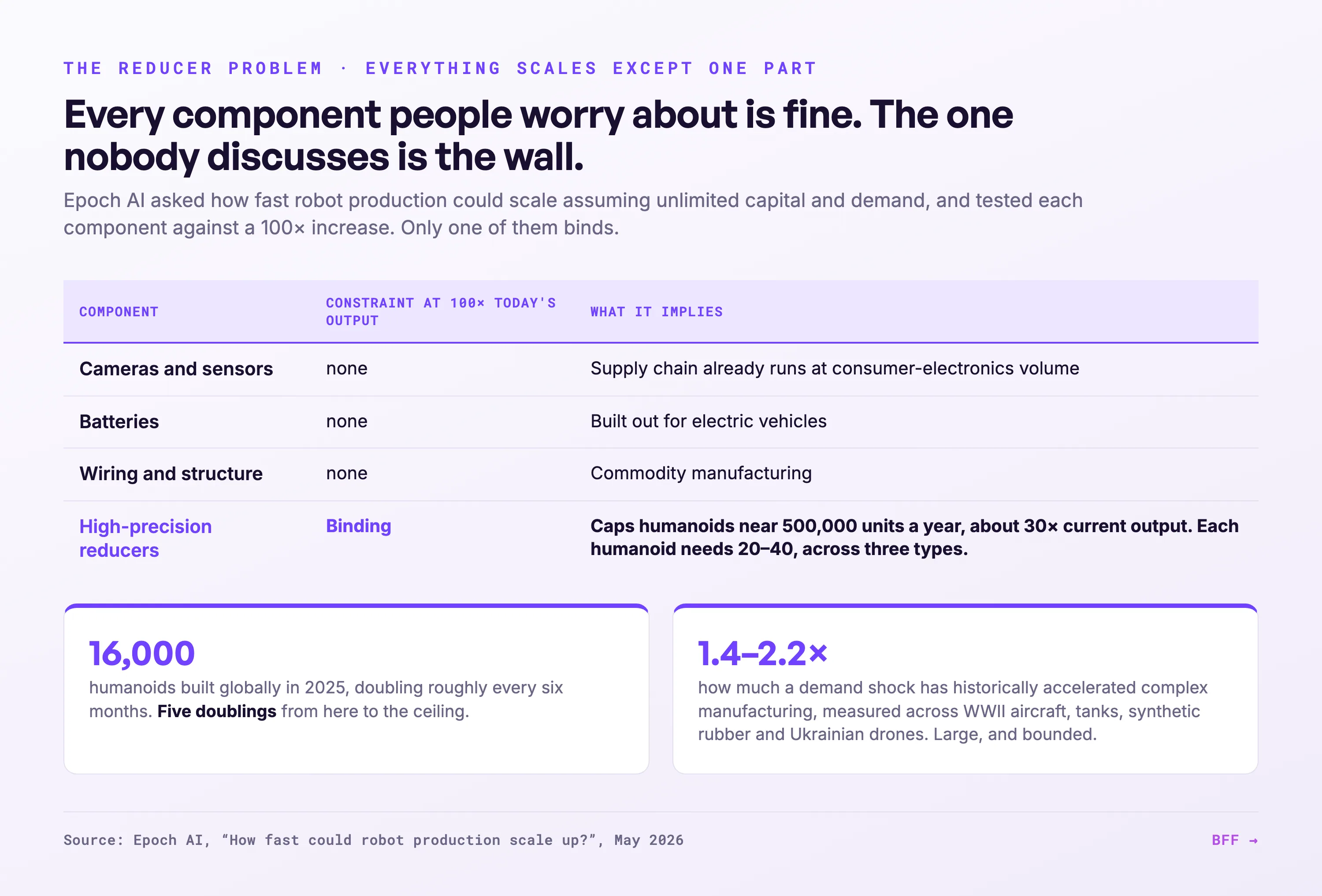
According to Epoch's analysis, a single humanoid needs between 20 and 40 of these across the three types.
I did that multiplication expecting to find the constraint somewhere else. It is not somewhere else. A million humanoids a year, a figure several companies have named as an ambition, requires 20 to 40 million precision reducers a year. The current global industry produces a small fraction of that, and it is an industry with long qualification cycles, specialised machine tools and a handful of established suppliers.
Epoch concludes that reducers are the closest thing to a binding constraint in the whole bill of materials. Epoch puts the ceiling at 500,000 humanoids a year, with quadrupeds at 750,000.
What makes this finding sharper is what sits beside it. The same analysis reports that cameras, sensors, batteries and wiring present no meaningful constraint even at a hundred times current production. Every component people worry about is fine. The one nobody discusses is the wall.
That asymmetry is worth sitting with, because it explains why the constraint stayed invisible for so long. Public attention followed the components that were scarce during the last technology cycle, and semiconductors, batteries and sensors all had their moment as the thing that would hold everything up. Each of those industries responded by building enormous capacity, and they now have it. Precision gearing had no such cycle. It served the machine-tool and industrial-automation markets, which grow steadily and predictably, and it built the capacity those markets needed. Nobody in that supply chain was planning for a category that doubles every six months, because until three years ago no such category existed.
05
3. What history says about demand shocks
The obvious objection is that constraints move when enough money arrives. Epoch tested that against the historical record rather than asserting it either way, and we find the method more useful than the conclusion.
Epoch writes that it looked at cases where a sudden demand shock hit complex manufacturing and measured how much the annual growth multiplier changed. American fighter aircraft in the Second World War went from an annual multiplier of 1.25 to 2.8. Soviet tank production moved from 1.32 to 1.91. Synthetic rubber, built from almost nothing under wartime priority, went from 1.0 to 4.65. Ukrainian FPV drone production, the most recent case, moved from 1.11 to 1.32.
Across those cases a demand shock accelerates production by 1.4 to 2.2 times the previous growth rate. That is a large effect and a bounded one. It is not the unlimited elasticity that a forecast built on capability improvement quietly assumes.
Applied forward, Epoch estimates humanoid output by 2030, three years after a hypothetical shock at the end of 2027, at 1.5 to 3 million a year as clearly achievable, 5 to 10 million as plausible, and anything above 15 million as requiring things to go unusually well. We would carry those as scenarios rather than forecasts, which is how they are published.
The historical comparison deserves one caveat that we would put more weight on than the piece does. Wartime production ran under conditions no commercial market reproduces: guaranteed offtake, suspended competition, directed labour and no requirement to make a profit. That the multiplier tops out around 2 to 4 under those conditions makes it a generous ceiling for a commercial ramp, not a conservative one.
06
4. The ceiling, and what sits under it
Two further constraints sit under the reducer, and both are more tractable.
Epoch puts factory construction at six to nine months in China and upwards of two years in Western countries, and notes that retrofitting an existing automotive plant brings the Western figure down to six to ten months. That difference is the single largest geographic asymmetry in the whole analysis, and it is not about labour cost or subsidy. It is about permitting, grid connections and the availability of crews, which is precisely the constraint our electrotech dossier traced through the Dutch grid queue.
I went looking for a second independent estimate of reducer capacity and did not find one. Trade associations report machine-tool output and robot shipments; nobody I could find publishes precision-reducer capacity as a series. That absence is itself informative, because a component that constrains an entire industry usually has an analyst covering it, and this one appears not to. It also means the 500,000 figure in this dossier rests on one model, which is a caveat we return to in section 9.
Labour is the third. Reaching ten million humanoids a year would require 40,000 construction workers to build the capacity and between 40,000 and 120,000 people to operate it. There is an irony there that we would not lean on, because the numbers are small against a national labour market. A technology sold on labour scarcity needs people to build it, and not many.
The reducer remains the one that binds. Five hundred thousand units a year, thirty times today's output, and every announcement about capability lands on the far side of it.
07
5. The other direction: fabrication is getting cheaper too
A dossier that stopped there would be half the story, because a countervailing movement is running at the same time and it is the one that generates the headlines.
In June, researchers at Tsinghua reported a printing method that forms an object in 0.6 seconds by firing patterned light into a vat of resin from multiple angles, hardening the material wherever the beams overlap rather than building it layer by layer. Researchers at Meiji University describe a machine called Functgraph that prints components for its own tools, picks them up, assembles them and then uses them, which is a research demonstration rather than a product but an unusually direct one. Containerised microfactories with swappable tooling have been demonstrated at five thousand dollars. Xiaomi reports a finished car every 76 seconds at a plant running more than 700 robots, with 381 of them in a body shop staffed by 20 people, and the outlet that carried the claim noted the figure was aggressive.
The trajectory these point at is real. Making a physical thing is getting faster, cheaper and more automatic, and the tools that make the tools are themselves getting cheaper.
We would attach one caveat to the most-shared item on that list, because it is routinely dropped. The 0.6-second print is at millimetre scale. The researchers state that scaling beyond millimetres is the open question. A method that forms a millimetre-scale object almost instantly is a genuine advance in bioprinting and microfabrication, and it is not a manufacturing revolution until it is something you can do to a part.
The pattern in how these items travel is consistent enough to be worth naming. A laboratory result arrives with its scale, its conditions and its open questions attached. Within a week the scale has fallen off, and what remains is a video of something appearing in under a second next to a caption about the future of manufacturing. Our authenticity-crisis dossier documented the same mechanism in fraud statistics, and the fix is the same: read the qualification the researchers themselves put in, because it is almost always the sentence that got removed.
None of this means the fabrication story is soft. Desktop and containerised manufacturing genuinely compresses the cycle from design to physical part, and it does so for a class of components that used to require tooling, minimum order quantities and a supplier relationship. A workshop that can print a functional bracket overnight is doing something that took six weeks in 2015. That is a real change in how quickly a machine can be iterated, and it is part of why humanoid designs have moved as fast as they have.
08
6. Why the two movements do not meet
Here is the reconciliation, and it is the argument this dossier exists to make.
The fabrication revolution and the production ceiling operate on different classes of part. Additive manufacturing is transformative for geometry: complex shapes, low volumes, rapid iteration, parts that would be impossible or uneconomic to machine. A microfactory in a container is a superb way to make brackets, housings, custom end-effectors and one-off tooling.
A strain-wave reducer is none of those things. It is a high-volume, high-precision, metallurgically demanding component whose entire value is dimensional accuracy under repeated elastic deformation. It is made by grinding and heat-treating on specialised machine tools with long qualification cycles. Nothing about printing a part in 0.6 seconds touches that process, and nothing about a five-thousand-dollar microfactory addresses it either.
So both stories are true and they are about different things. The cost of making a shape is collapsing. The cost of making a precisely geared, fatigue-resistant mechanical transmission at scale is not, and the second is what a robot is mostly made of.
That distinction is the thing we would hold onto. When a demonstration of instant fabrication appears in a feed next to a humanoid announcement, the natural inference is that one enables the other. On the evidence, it does not.
There is a useful way to test any new fabrication claim against this. Ask which of three things it changes: the cost of a shape, the cost of a tolerance, or the cost of a volume. Additive methods have transformed the first and barely touched the second. Precision gearing is entirely a problem of the second and the third. A technique that halves the time to produce a complex geometry does nothing for a component whose difficulty is holding a few micrometres across a hardened steel surface that will flex several million times.
The same logic explains why the fabrication revolution has shown up so visibly in prototypes and so little in unit economics. Iteration speed is a design-phase benefit. Reducer capacity is a production-phase constraint. A company can iterate ten times faster and still be waiting the same eighteen months for gearboxes, and several of them currently are.
09
7. Where China's advantage actually sits
The geographic question follows directly from the previous two sections and it is more specific than the usual framing.
China's advantage in this category is not primarily labour cost and it is not primarily subsidy. It is that a factory takes six to nine months to build there and two years or more in most Western countries, and that the supply chain for precision mechanical components is dense, co-located and already running at volume for the machine-tool and automotive industries.
Our other-AI-race dossier argued that the United States exports intelligence while China exports the machines of the electric age. Reducers are exactly that pattern in miniature. The intelligence in a humanoid is increasingly commoditised and increasingly open; the gearbox is neither.
For a European manufacturer the practical reading is uncomfortable but narrow. The part of this industry that Europe is well placed for is the high-precision mechanical end, because that is where existing machine-tool and automotive competence transfers directly. The part it is badly placed for is speed of buildout, for the same permitting and grid reasons that our electrotech dossier traced through the Dutch connection queue. The bottleneck and the European strength are the same component, which is either an opportunity or an irony depending on how quickly anyone acts on it.
We would put that more concretely, because it is the most actionable thing in this dossier for a Dutch reader. The competence that makes a strain-wave reducer is the competence that already exists in the Dutch and German precision-engineering base: hardened-steel machining, heat treatment, metrology, tolerance control, and the quality systems that let a customer qualify a component and then buy it for a decade. Those are not skills that a robotics startup acquires by hiring software engineers. They are skills that take a supplier fifteen years to build and that the Netherlands, Germany, Switzerland and northern Italy have been building continuously since long before anyone used the word humanoid.
What Europe does not have is the willingness to build capacity against a demand curve nobody has signed for. A precision-gearing manufacturer looking at this market sees a category doubling every six months, dominated by companies with no delivery history, whose published order books are mostly pilots. Adding a production line means committing capital and a two-year lead time against that. The rational move for any individual supplier is to wait for firm orders, and the aggregate effect of everyone being rational is the ceiling described in this dossier.
That is the shape of the opportunity and the reason it stays open. Whoever moves first carries the risk that the demand does not arrive; whoever moves last finds the qualification slots taken. It is a genuinely hard call and we would not pretend otherwise, but it is a call about a component, made by companies that already exist, and not a call about whether robots will be able to fold laundry.
10
8. What we would do on Monday
This dossier is more strategic than operational, so three moves rather than four, and they are about how to read the field rather than what to buy.
Read capacity announcements as capacity, not as delivery. Figure's one-an-hour and 1X's 10,000-unit target are statements about a plant's design point, made by the company that owns the plant. They are not shipments. The number we would track instead is units delivered to third parties, which is published far less often and means considerably more.
Watch the component layer, not the robot layer. If reducers are the binding constraint, then the informative announcements over the next two years are about reducer capacity, new entrants to precision gearing and qualification of alternative designs. Those are the signals that move the ceiling, and they appear in trade press rather than in technology coverage.
Treat the doubling time as the number to watch, not the unit count. Sixteen thousand units is a small number and a six-month doubling is a fast one, and the second matters more than the first. A category on that curve passes half a million in two and a half years, which is where the ceiling described here starts to bind. The useful question for any board looking at this is not how many robots exist today but how many doublings sit between today and the constraint, and the answer at present is five.
And separate the two stories when they arrive together. A fabrication demonstration and a production announcement look like the same story and are not. The test we would apply is simple: does this technique make a precision transmission cheaper at volume? If not, it is a story about geometry, which is genuinely interesting and does not move the number in section 1.
11
9. Where we could be wrong
The constraint may be designed around rather than expanded. Our whole argument treats reducer capacity as the ceiling. Several groups report work on direct-drive and quasi-direct-drive actuation that reduces or eliminates high-ratio gearing, trading precision for compliance and control. If that approach matures, the bottleneck we have built a dossier on becomes a design choice rather than a wall.
Epoch's analysis is one model. The 500,000-unit figure, the historical multipliers and the 2030 ranges all come from a single published analysis. It is careful, it publishes its method, and it has not been independently replicated. We have leaned on it heavily because it is the only work we found asking this question quantitatively, and that is a reason for caution rather than confidence.
Chinese reducer capacity may be larger than the estimates assume. Precision component manufacturing in China is less visible than final assembly, and capacity estimates for it are inferred rather than reported. If domestic capacity is higher than believed, the ceiling moves and the geographic asymmetry widens rather than binds.
The ceiling may be a price rather than a wall. We have written reducer capacity as a hard limit, and capacity constraints in mature industries usually express themselves as price first. If demand runs at three times supply, the outcome is not that production stops at 500,000 units but that reducers get more expensive, that the cost shows up in the price of a robot, and that the market clears at a smaller volume than the forecasts assume. That is a different argument from the one we have made and it points at the same place, but the mechanism matters if you are the one setting a price.
And demand may simply not be there. This entire dossier assumes the demand exists and asks whether supply can meet it. The humanoid order books published so far consist mostly of deployment agreements and pilots rather than purchases, and a constraint that binds at 500,000 units a year is irrelevant if the market wants 50,000.
12
10. What we are watching
Reducer capacity announcements. New plants, new entrants, or a credible qualification of a lower-precision alternative. This is the number that moves the ceiling, and it will show up first in machine-tool trade coverage.
Third-party delivery figures rather than production capacity. The gap between a plant's design point and units actually shipped to customers is where the next eighteen months of this story lives.
Whether direct-drive designs ship at volume. If a major manufacturer moves away from high-ratio gearing entirely, the argument in this dossier changes shape and we would say so.
Whether anyone starts reporting reducer capacity as a series. At the moment it is inferred rather than published, which is why the central figure in this dossier rests on a single model. A trade body or an analyst putting out a quarterly capacity number would change how this whole question can be argued, and it would probably appear first in machine-tool statistics rather than in robotics coverage.
And the Western buildout timeline. Epoch puts Western factory construction at two years, or six to ten months with an automotive retrofit. Whether anyone in Europe actually executes that retrofit, and how long the grid connection takes, is the practical test of whether the continent participates in this at all.
13
11. Verification and sources
| Claim | Confidence | Note |
|---|---|---|
| 2025 production: ~16,000 humanoids (doubling ~6 months); ~81,000 quadrupeds (~10 months); ~570,000 robotic arms (~8 years); ~33m wheeled robots; ~16m drones | High | Epoch AI production-scaling analysis, May 2026. Estimates with a published method. |
| High-precision reducers are the closest thing to a binding constraint; capacity caps humanoids near 500,000 units a year, roughly 30x current output, and quadrupeds near 750,000 | High | Same source. The load-bearing claim of this dossier, and it rests on one analysis. |
| A humanoid requires 20-40 reducers across three types: planetary, cycloidal and strain-wave | High | Same source. |
| Cameras, sensors, batteries and wiring present no meaningful constraint even at 100x current production | High | Same source, and the finding that isolates the reducer. |
| Factory construction runs 6-9 months in China and 2+ years in Western countries; automotive retrofit brings the Western figure to 6-10 months | High | Same source. |
| Ten million humanoids a year would require ~40,000 construction workers and 40,000-120,000 operational staff | Medium-high | Same source. A modelled derivation rather than an observation. |
| Historical demand shocks accelerated complex manufacturing by roughly 1.4 to 2.2 times: WWII fighter aircraft 1.25 to 2.8, Soviet tanks 1.32 to 1.91, synthetic rubber 1.0 to 4.65, Ukrainian FPV drones 1.11 to 1.32 | High | Same source. We add the caveat that wartime conditions are a generous ceiling for a commercial ramp, not a conservative one. |
| By 2030: 1.5-3m humanoids a year clearly achievable, 5-10m plausible, above 15m requires things going unusually well | Medium-high | Same source, published as scenarios following a hypothetical end-2027 shock. Carried as scenarios. |
| Figure: one robot per hour at BotQ as of May 2026, up from one per day in under 120 days, a 24-fold increase; plant designed for 12,000 units a year with a stated path to 100,000 | High | Figure's own announcement and contemporaneous reporting. A company describing its own capacity. |
| 1X opened a vertically integrated factory in Hayward on 30 April 2026, targeting 10,000 NEO units in year one and 100,000+ by end-2027 | High | 1X press release. A capacity target, not a delivery figure. |
| 1X agreed with EQT in December 2025 to deploy up to 10,000 NEO units across portfolio companies between 2026 and 2030 | Medium-high | Company announcement. A deployment agreement rather than a purchase order. |
| Tsinghua demonstrated volumetric printing of objects in 0.6 seconds using patterned light | Medium | Contemporaneous reporting, June 2026. Millimetre scale. The researchers state that scaling beyond that is the open question, and dropping that qualification changes the claim. |
| Functgraph at Meiji University prints components for its own tools, assembles them and uses them | Medium | Contemporaneous reporting. A research demonstration, not a product. |
| Containerised microfactories with swappable tooling at around $5,000 | Low to medium | A single demonstration and a vendor claim. Carried as illustration rather than evidence. |
| Xiaomi claims a car every 76 seconds with 700+ robots; 381 robots to 20 people in the body shop | Low to medium | Contemporaneous reporting, March 2026, which described the figure as aggressive. Carried as a company claim. |
| "10,000 orders in the first five days" for 1X NEO | Not used | Traces to a single social post and does not appear in the company's own announcement. The verified 10,000 is the EQT deployment agreement. |
Charts labelled "BFF" are our own, drawn from the sources named beneath them.
Dossier as pdf
Download this dossier
The full dossier as a pdf, with every figure and the source list. Fill in your details and the download starts right away.

Ruben Horbach
Co-founder · Back From the Future
Ruben researches how organisations adopt AI meaningfully — not as technology, but as a change in work and people. He builds the agent infrastructure behind BFF and speaks about the near future of work.