
In short
- US suspects a leading-edge ASML tool reached China, testing the export-control strategy for the first time.
- The entire Western semiconductor strategy rests on one assumption: EUV machines can't slip through.
- ASML expects ~20% of 2026 revenue from China, creating permanent structural pressure on the chokepoint.
- IBM's sub-1nm chip shows the frontier has a decade of runway, raising the cost of any single leak.
- Watch three things: the ASML allegation, the DUV ban in Congress, and China reaching leading-edge without ASML.
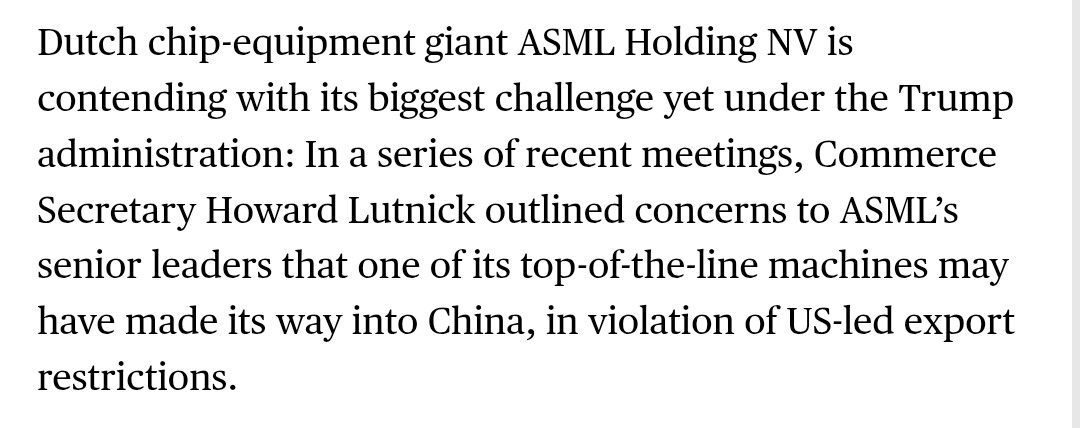
In mid-June, Commerce Secretary Howard Lutnick told ASML's leadership that one of its top machines might have made its way into China, in violation of US-led restrictions (Bloomberg, June 19, 2026). Senior administration officials went further, raising alleged shipments of EUV components and accusing the company of prioritising short-term profits over national security. ASML denies all of it and says it is fully compliant.
I want to be careful here, because an allegation is not a finding and nothing has been substantiated. The moment still matters, because the entire Western strategy on advanced semiconductors rests on a single assumption and this is the first time that assumption has been publicly questioned at this level.
The theory of the chokepoint
The logic behind export controls is elegant. You can design a chip anywhere, since a laptop and a whiteboard and a talented team will get you a world-class architecture. What you cannot do is fabricate a bleeding-edge chip without a handful of machines that only a few companies on earth know how to build.
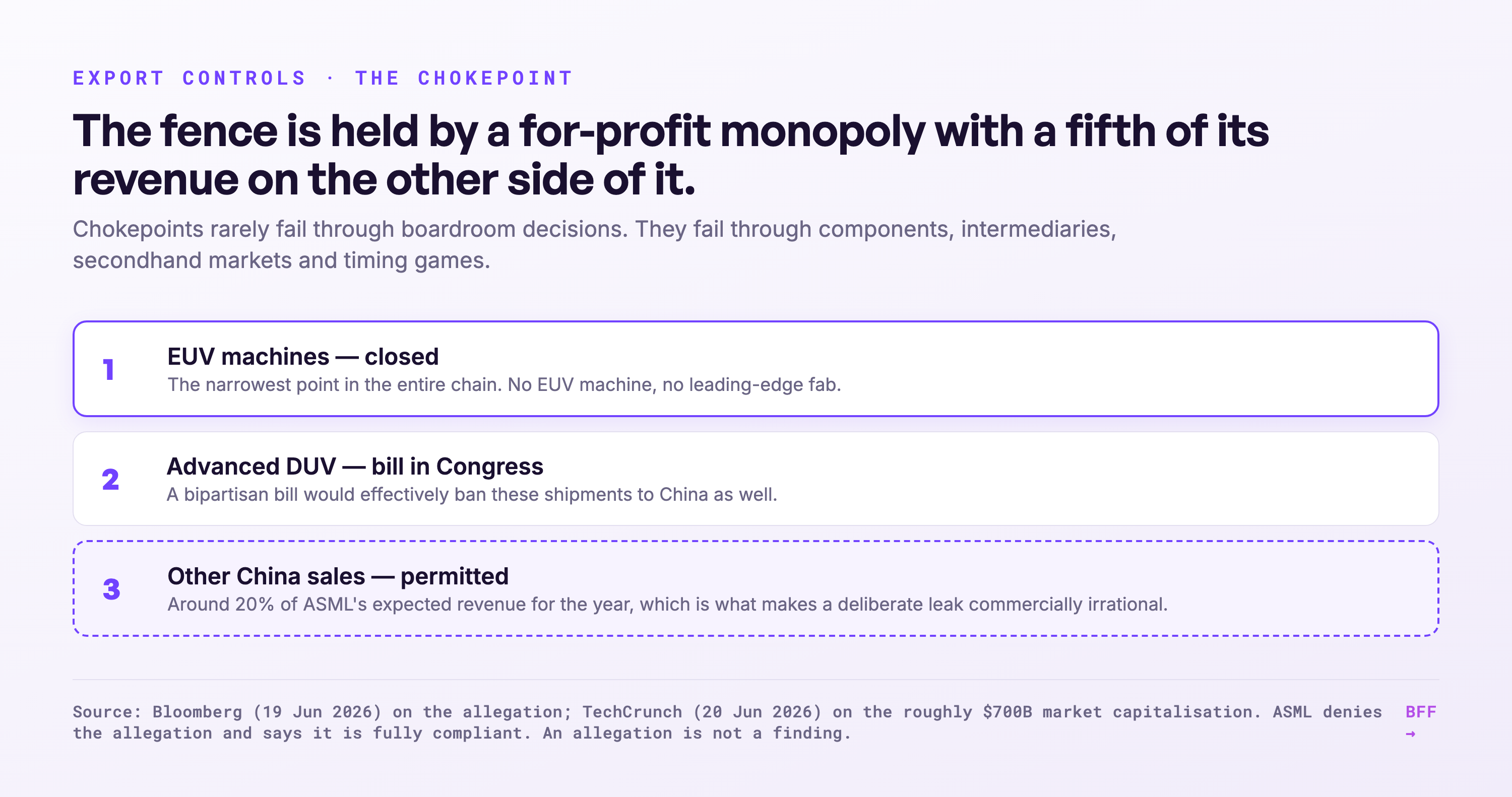
ASML's extreme ultraviolet lithography systems are the narrowest point in that entire chain. No EUV machine, no leading-edge fab. That is why the Netherlands, under US pressure, has restricted ASML from selling EUV machines and some advanced immersion DUV equipment to China. Control the tools and you control the frontier.
The monopoly this creates is enormous. ASML is Europe's most valuable public company, with a market capitalisation around $700 billion, driven up sharply by AI chip demand (TechCrunch, June 20, 2026). One company, one country, one chokepoint.
And it is about to get tighter. A bipartisan bill moving through Congress would effectively ban all of ASML's DUV shipments to China, the less advanced tools that account for roughly a fifth of the company's expected 2026 revenue. The EUV ban was the fence around the frontier. The DUV bill fences off the territory well behind it.
A chokepoint held by a for-profit monopoly with a fifth of its revenue on the other side of the fence is a chokepoint under permanent structural pressure.
Why the incentives cut both ways
Here is the tension nobody in The Hague or Washington says out loud. ASML expects roughly 20% of its 2026 revenue to come from already-permitted sales to China, which makes a deliberate leak commercially irrational. Risking the entire China business, plus the company's political standing, over a single illegal sale does not add up on any spreadsheet I can construct.
Chokepoints rarely fail through boardroom decisions, though. They fail through components, intermediaries, secondhand markets and timing games. The enforcement history already shows the pattern: under the previous administration there was deep frustration when ASML accelerated shipments of soon-to-be-banned DUV gear before the controls officially took effect. Legal at the moment of shipment, and corrosive to the strategy all the same.
A chokepoint held by a for-profit monopoly with a fifth of its revenue on the other side of the fence is a chokepoint under permanent structural pressure.
The stakes rise with every node
Now set this against where the frontier is going. On June 25, IBM unveiled the world's first sub-1 nanometre chip technology, a 0.7 nm node at 7 angstroms, built on a new vertically stacked transistor architecture (IBM Newsroom, June 25, 2026). The claims are concrete: up to 50% more performance and 70% greater energy efficiency against its 2 nm chips, and nearly 100 billion transistors on a fingernail-sized die, close to double its 2021 density (New Atlas). IBM's roadmap runs all the way to 1 angstrom, which its director Jay Gambetta described as a platform that can enable scaling for another decade (The Register, June 25, 2026). Those are the company's own figures on unreleased technology, so I would treat the performance numbers as a target rather than a result.
For comparison, the cutting-edge nodes Intel and TSMC are preparing for 2028 production sit at 14 angstroms. On IBM's roadmap the frontier has ten more years of runway.
Every node shrink makes the tools more valuable to control, and it makes a single leak more expensive. If the gap between the frontier and the fence keeps widening, the machines behind that fence become the most strategically concentrated objects in the world economy. One tool slipping through in 2020 meant losing a two-year lead. One tool slipping through in the angstrom era could mean losing a decade of compounding advantage.

The question that changed
China is working the problem from both ends. Huawei claims a LogicFolding architecture that could reach 1.4nm-class chips by 2031 without EUV at all. That may be real and it may be positioning, and I do not think anyone outside the company can currently tell. Either way, the West's strategy assumed the answer to whether China can reach the leading edge was "not without our machines."
A chokepoint only works while it stays choked. The moment one tool slips through, the question stops being whether China can catch up and becomes how long the gap really was, and how much of the last five years of policy was built on a fence with a hole in it.
Three things are worth watching from here: whether the ASML allegation is substantiated, whether the DUV ban passes Congress, and whether anyone in China demonstrates a working leading-edge node without ASML's help. Any one of those answers rewrites the strategy. Two of them rewrite the map.

Ruben Horbach
Co-founder · Back From the Future
Ruben researches how organisations adopt AI meaningfully — not as technology, but as a change in work and people. He builds the agent infrastructure behind BFF and speaks about the near future of work.