
In short
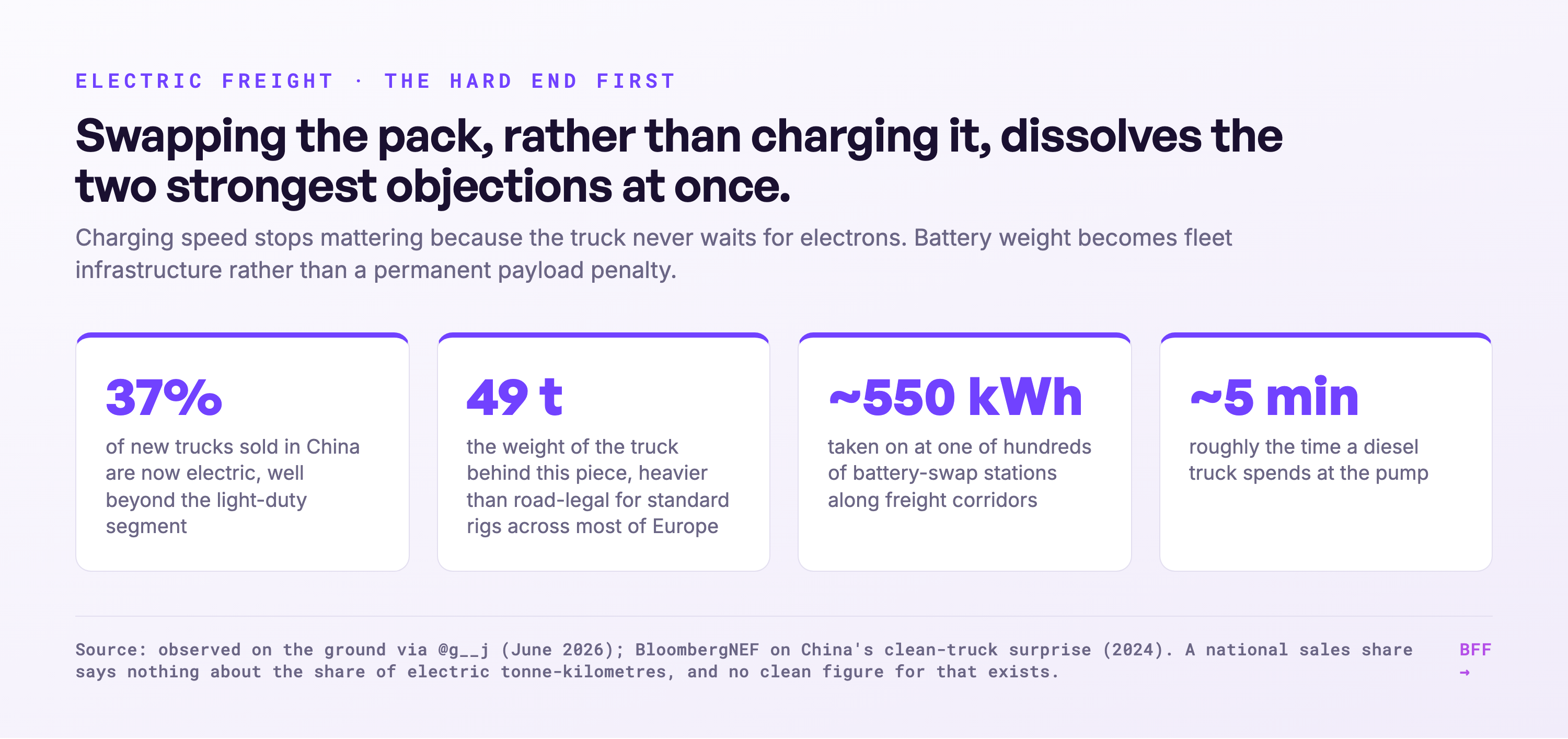
- 37% of new trucks sold in China are now electric, upending the usual electrification sequence.
- Battery-swap stations refuel heavy trucks as fast as diesel, dissolving charging-speed and battery-weight objections.
- China questioned the premise (every truck carries its own battery) rather than debating the conclusion.
- The same pattern shows in electric container ships, mining haulage, and 4TW of installed capacity.
- Europe is still debating whether the wall exists while China drives around it.
37% of new trucks sold in China are now electric.
Sit with that for a second, because it breaks the mental model most of us carry around. The Western assumption runs like this: passenger cars electrify first, then delivery vans, then maybe, decades from now, heavy freight. Batteries are too heavy for trucks, charging takes too long, and the freight backbone stays on diesel until physics changes.
China's number says the sequence is running in a different order there, and the interesting part is how.
The truck that shouldn't work
The truck that prompted this piece weighs around 49 tonnes, which is heavier than what is road-legal for standard rigs in the UK or most of Europe. It is exactly the category sceptics point to when they explain why electric trucking hits a wall, because the heavier the load the bigger the battery, and the more of your payload you give up to carry your own energy around.
This truck was never plugged into a charger overnight. It pulled into one of hundreds of battery-swap stations and traded an empty pack for a full one in roughly the time a diesel truck spends at the pump.
That single design choice dissolves the two strongest objections at once. Charging speed stops mattering, because the truck never waits for electrons and the battery charges on a rack while the truck is already back on the road. Battery weight becomes a fleet-management variable rather than a fixed penalty, because the pack is infrastructure now, owned and cycled by the network instead of dragged around as a permanent cost of the vehicle.
Range anxiety turns into a logistics problem. Logistics problems get solved. Physics problems do not.
Range anxiety turns into a logistics problem. Logistics problems get solved. Physics problems don't.
The assumption the West never questioned
Most of the Western debate about electric freight rests on one unexamined premise, which is that every truck carries its own battery and waits for a charger. Every white paper about grid load, every op-ed about charging deserts, every fleet-operator survey about downtime starts from that model, and the conclusion that heavy freight cannot electrify soon is already baked into the premise.
China questioned the premise instead of arguing about the conclusion. Decouple the battery from the truck, standardise the pack, build the swap network along freight corridors, and the whole objection stack collapses.
This is not a one-off experiment either. BloombergNEF was writing about China's "clean-truck surprise" defying the EV slowdown narrative back in 2024, and the swap-station count has grown into the hundreds since. What looked like a curiosity two years ago is now more than a third of new truck sales. I would add one caveat: national sales share does not tell you how much of the actual tonne-kilometre work is electric yet, and I have not seen a clean figure for that.
Part of a larger pattern
Zoom out and the truck story stops being about trucks. In June, China became the first country in history to pass 4 terawatts of installed electricity capacity, with 62% of it non-fossil. A 10,000-tonne fully electric container ship carrying 742 containers entered commercial operation this spring. BYD demonstrated charging speeds comparable to filling a petrol tank. Fleets of autonomous electric mining trucks are already running.
Each of those is the hard case, the one Western analysis files under "eventually": container shipping, heavy freight, mining haulage, grid-scale capacity. The pattern running through all of them is the same. Pick the segment everyone agrees is hardest, redesign the system around its constraints, and electrify it while the rest of the world is still modelling whether it is feasible.
There is a familiar rhyme here. "Nobody wants EVs" has been a journalism genre for a decade, and over that same decade EV share of new UK car sales went from 0.3% to 25%. The genre survived. The premise did not.

Why the backbone matters
The easy end of trucking was never the test. Anyone can electrify a last-mile delivery van doing 80 kilometres a day and parking at a depot every night. The backbone is the test: long-haul, maximum-weight, minimum-downtime freight, the stuff economies actually run on.
That is the part China is electrifying first, and once the backbone runs on electrons everything downstream inherits the change. Freight costs decouple from oil prices. Depots turn into grid assets, because thousands of swap-station batteries charging on racks are also storage the grid can draw on. And the operational data from millions of electric freight kilometres compounds into an advantage no pilot programme can replicate.
For European fleet operators and policymakers the uncomfortable question is timing, because the debate here is still about whether the wall exists while somewhere else 37% of new trucks are already driving around it.
The question I would take into your own industry: which of your physics problems are actually logistics problems wearing a disguise?

Ruben Horbach
Co-founder · Back From the Future
Ruben researches how organisations adopt AI meaningfully — not as technology, but as a change in work and people. He builds the agent infrastructure behind BFF and speaks about the near future of work.