

01
Why this, why now
Every technology panic asks whether the machines will take the jobs. Our answer in 2026 remains narrower and stranger: so far they mostly take the first job, the one where people used to learn how to have the others.
Three things have changed since the July edition, and they pull in different directions, which is why we rewrote this dossier rather than patched it.
There is now a name for the mechanism. Researchers describe employers restructuring junior postings with senior-level requirements, judgement, stakeholder management, the ability to evaluate work rather than produce it, and call the pattern seniorization. That is the link we were missing in July: it explains how the number of entry-level postings can hold up while the number of jobs a graduate can actually get does not.
The outcome data got worse in a specific way. The New York Fed put underemployment among recent college graduates at 42 percent this spring, the highest since 2020. Graduates are finding work; a great deal of it does not use the degree.
And the counter-case got stronger, which the July edition would not have wanted to hear. Several careful analyses now argue that weak hiring generally, rather than AI specifically, explains most of what is being attributed to AI, and at least one credible body finds no clear aggregate AI effect on the labour market at all. Section 12 takes that seriously.
Timeline
- May 2023 · IBM's chief executive says AI will replace roughly 7,800 back-office jobs. The junior-replacement era gets its flagship.
- May 2025 · SignalFire reports new-grad hiring at large technology firms down 50 percent against 2019.
- Aug 2025 · Stanford's canaries study finds a 13 percent relative employment decline for 22-to-25s in AI-exposed jobs.
- Feb 2026 · IBM reverses: entry-level hiring tripled, the roles rewritten around what AI cannot do.
- Apr 2026 · Entry-level postings calling for AI skills nearly double year on year.
- Spring 2026 · Recent-graduate underemployment reaches 42 percent, the highest since 2020.
- 2026 · Seniorization is named: junior roles rewritten with senior requirements.
02
Contents
1. The squeeze is real
2. The canaries: what the best data shows
3. Seniorization: the mechanism the postings hide
4. The counter-evidence, honestly weighed
5. The IBM boomerang
6. What the first rung was actually for
7. Eating the seed corn: the pipeline arithmetic
8. Who carries the cost
9. What the job becomes
10. The apprenticeship problem
11. What smart organisations do with the first rung
12. Where we could be wrong
13. What we are watching
14. Verification and sources
03
1. The squeeze is real
Start with the measurements, because this is a field where the anecdote runs far ahead of the data and the data is now good.
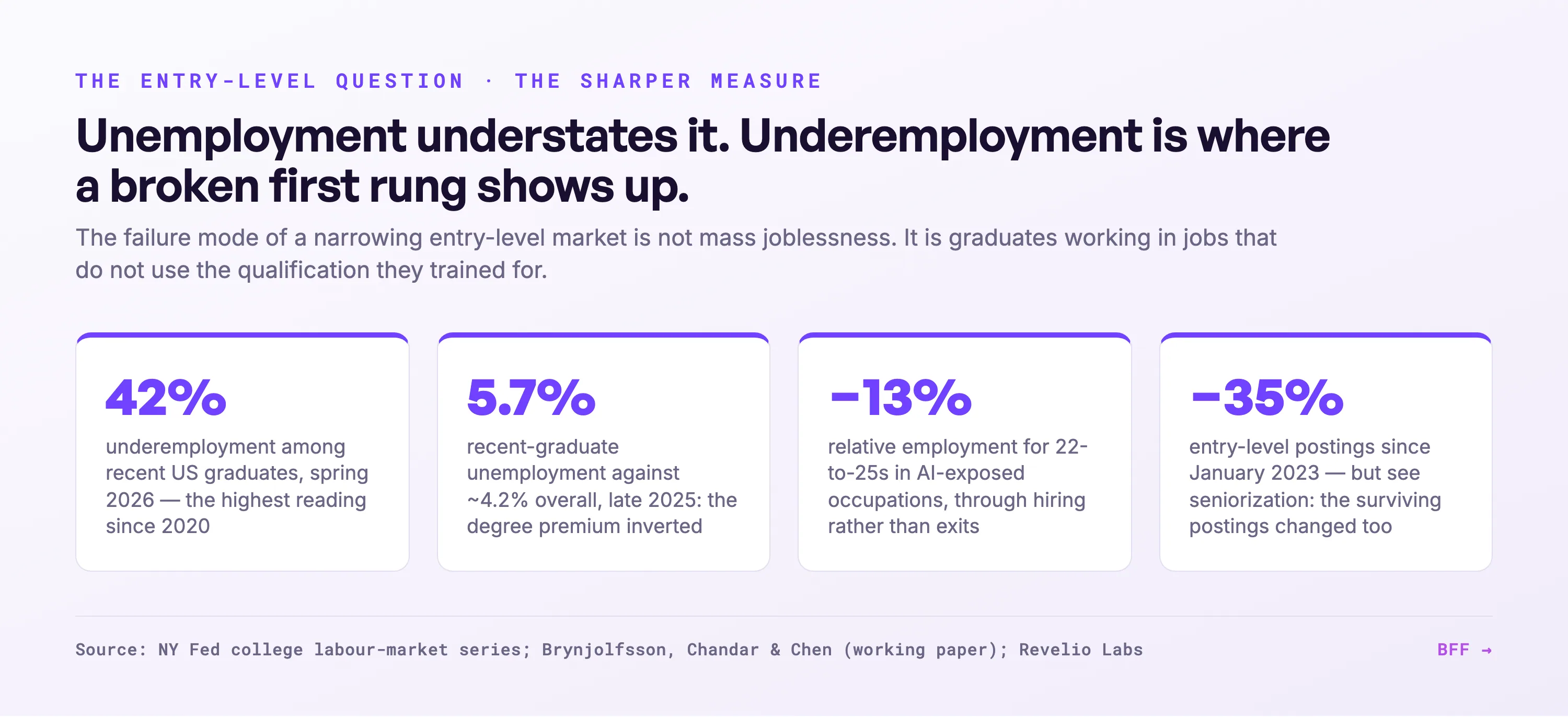
Revelio Labs reports entry-level postings down roughly 35 percent since January 2023, with technology down about 25. SignalFire, which counts people actually beginning jobs rather than adverts placed, reports new-role starts for people with under a year of experience down about 50 percent between 2019 and 2024, with new graduates falling to 7 percent of large-technology hires and from 30 percent to under 6 percent at startups.
The outcome measures follow. Recent-graduate unemployment ran around 5.7 percent against roughly 4.2 percent overall in late 2025, an inversion of the historical pattern in which a degree protected you. Graduates are now unemployed for longer than people with only secondary education, which is the part that should worry anyone selling a degree.
And this year the sharper measure arrived. The New York Fed estimates underemployment among recent graduates at 42 percent this spring, the highest reading since 2020. Unemployment counts people without work. Underemployment counts people working in jobs that do not require their qualification, and for this question we think it is the better number, because the failure mode of a broken first rung is not mass joblessness. It is a generation working, and not learning what they trained for.
04
2. The canaries: what the best data shows
The single most careful study in this field is Brynjolfsson, Chandar and Chen's canaries paper, first published in August 2025 and updated that November, built on ADP payroll records rather than surveys or postings.
Its finding is oddly specific, and the specificity is what makes it credible. Employment effects concentrate almost entirely on workers aged 22 to 25 in AI-exposed occupations, they run through hiring rather than firing, and older colleagues doing the same jobs are untouched or growing. The relative decline for that group is about 13 percent.
Anthropic's own labour-market work, measuring observed usage rather than theoretical exposure, finds a comparable figure: job-finding down about 14 percent for 22-to-25s in exposed occupations. Two independent datasets, two different methods, landing within a percentage point of each other, is as close to corroboration as this field gets.
Note what the shape rules out. If AI were replacing workers wholesale, you would expect exits, and you would expect them across age groups. Instead the door is closing rather than people being pushed out of it, which is both less dramatic and harder to fix, because nobody is laid off from a job that was never advertised.
We want to pin down two things about the 13 percent, because the figure gets quoted loosely and the looseness matters.
It is a relative decline, not an absolute one. The comparison is against similar workers in occupations with less AI exposure over the same period, which is the right way to isolate an effect and also means the headline cannot be read as "13 percent of these jobs disappeared". In a rising market the group could grow and still show this result.
And the exposure classification is doing a great deal of work. An occupation counts as exposed on the basis of what the tasks in it look like, and reasonable people build those mappings differently. Anthropic's version, which measures what people actually do with the tools rather than what they theoretically could, is in our view the better instrument, and it lands at 14 percent against Stanford's 13. That the two agree so closely while measuring exposure by different definitions is the fact we find most persuasive in this dossier, and it is more persuasive than either number on its own.
05
3. Seniorization: the mechanism the postings hide
Here is the addition that reorganises the rest of the dossier.
The July edition treated posting counts and hiring outcomes as two measures of the same thing, and worried when they disagreed. Research this year suggests they disagree because employers changed what a junior posting contains. The pattern, now called seniorization, is that entry-level roles get rewritten with senior-level requirements: judgement, stakeholder management, the ability to review and evaluate output rather than generate it.
That resolves several things at once.
It explains how postings can recover while graduate outcomes do not. A posting still exists, and it is now addressed to someone with three years of experience who does not exist at entry level by definition.
It explains the 42 percent underemployment figure better than a simple volume story does. Graduates take the jobs that remain genuinely junior, which are increasingly the ones that do not use their qualification.
And it connects this dossier to the other two in the series. Our what-stays-human dossier argues that the scarce human contribution has moved from producing answers to vouching for them. Our learning-paradox dossier argues that judgement forms by doing the first-pass work. Put those together with seniorization and the trap is complete: employers now want judgement at entry level, judgement is built by doing the work that AI has absorbed, and the entry-level job was where that work used to live.
There is a related figure worth having next to it. I read it as the hopeful story on first pass. Roughly 35 percent of entry-level postings now ask for AI skills, and the share of full-time postings mentioning AI nearly doubled year on year to about 4.2 percent. Read carelessly, that looks like a hopeful story about new skills opening doors. Read alongside seniorization, it is at least partly the same phenomenon: a rising bar on a job that used to be defined by not yet having cleared one.
06
4. The counter-evidence, honestly weighed
We think the squeeze is real and that the panic overshoots it, and both halves need stating.
Software engineering postings on Indeed troughed in mid-2025 and inflected upward. Employers project hiring for the class of 2026 above the class of 2025, though by how much depends on whom you ask, and the disagreement is instructive: one widely quoted projection puts it at 1.6 percent and another at 5.6 percent. Adjusted for a growing number of graduates, the lower figure is a contraction in opportunity dressed as growth, and the higher one is roughly flat. Around 45 percent of employers describe the market for new graduates as merely fair, which is a downgrade from previous years and also not a collapse.
Openings persist and cluster. Healthcare, cybersecurity, the skilled trades and AI-native graduate programmes are hiring. The graduates who land those roles lean on internships, portfolios and referrals far more than on applications, which is a real finding with an uncomfortable distributional edge: those three things correlate with having a network, and a network correlates with where you started.
I want to sit with the two projections for a moment, because the gap between 1.6 and 5.6 percent is larger than it looks and the reason is instructive.
I went looking for the fieldwork behind both numbers, because that is usually where the answer sits. Employer surveys of this kind ask a sample of member organisations what they expect to hire, at a point in the year, against a base they define themselves. Move the fieldwork from autumn to spring and you catch a different mood. Change the composition of the panel towards large employers and the number rises, because large employers hire in programmes and programmes are planned. Ask about headcount rather than about roles and the answer changes again. None of that is manipulation; it is what happens when two organisations measure a soft quantity with different instruments.
We report the disagreement rather than resolve it, because it sits either side of the line that matters. The number of graduates entering the market grows most years. A projection of 1.6 percent more hiring against a larger cohort is fewer opportunities per graduate, and a projection of 5.6 percent is roughly flat to slightly better. So the two credible surveys are not disagreeing about magnitude, they are disagreeing about direction, and anyone quoting one of them as the state of the graduate market is choosing a conclusion.
I would treat both as weak evidence and watch the outcome data in section 1 instead, on the general principle that what employers say they will hire in March is a worse predictor than what they actually hired last year.
07
5. The IBM boomerang
The most instructive story here is one company changing its mind in public.
In May 2023 IBM's chief executive said AI would probably replace roughly 7,800 back-office roles, and the quote became the flagship of the junior-replacement era. In February 2026 the same company reported tripling its entry-level hiring, with the roles rewritten around what AI cannot do.
Read that arc carefully, because it is more than a reversal. IBM did not conclude that AI could not do the work. It rewrote what juniors are for, which is seniorization arriving at a company that then had to hire for it. And there is a cost signal underneath: mid-level talent was reportedly being poached at around a 30 percent salary premium, which is what a shortage of people who used to be juniors looks like on a payroll.
The broader pattern shows up in surveys. Orgvue reports that around 55 percent of employers who made AI-driven layoffs judged the decision wrong afterwards, and Forrester estimates half will be reversed by the end of 2026, which we quote as a forecast rather than a finding.
08
6. What the first rung was actually for
Before working out what breaks, we want to be precise about what the entry-level job did, because the phrase makes it sound like a place to park people until they are useful. It was never that.
Look at the professions that formalised it and the design is consistent. The articled clerk spent years drafting documents that a partner then corrected. The junior doctor took histories and presented them to a consultant who asked why. The apprentice made the joint again. The junior analyst built the model that the senior tore apart. In every case the junior produced work that somebody more experienced was going to check, and the checking was the teaching. The output had some value. The correction had all of it.
Two things made that arrangement stable. The junior's work was genuinely needed, so the organisation was not running a school out of charity, and the volume of it was high enough that the pattern-recognition had something to feed on. A trainee sees a thousand ordinary cases and thereby learns what an unusual one looks like, which is a kind of knowledge that cannot be transmitted by being told.
AI removes the first condition without touching the second. The work is no longer needed from the junior, because it can be produced faster and more cheaply elsewhere. The learning that the work used to carry is still needed, and it now has no vehicle. That is the whole problem in two sentences, and it is why "just train them differently" is harder than it sounds: the training was not a programme that sat alongside the work, it was a property of the work.
09
7. Eating the seed corn: the pipeline arithmetic
The structural consequence is arithmetic, and we would rather do the sum than assert it.
Suppose an organisation needs one senior specialist for every four juniors it hires, and it takes six years to convert a junior into a senior. Cut junior intake by half this year and nothing happens for six years. Then the senior pipeline halves, and it stays halved for as long as the intake stays cut, because you cannot recruit your way out of it at scale: everyone else made the same decision in the same quarter, and the mid-level premium in section 5 is the price of discovering that together.
Run the same numbers on a firm of a hundred people. Say twenty are juniors, and the intake is five a year to replace the four who leave or progress. Halve that to two or three and the firm looks identical for several years, because the seniors it has are the seniors it already had. In year six or seven the retirements start landing against an intake that was cut in year one, and by then the decision is untraceable: nobody writes "2026 hiring freeze" in the box marked "why we cannot staff this engagement".
Three features make this worse than an ordinary shortage.
The lag exceeds the tenure of the person who made the cut, so the decision and its consequence sit with different people, which is close to a design specification for a decision that keeps getting made.
The reversal is slower than the cut. Rebuilding takes the same six years; cutting takes one budget cycle.
And the cost is invisible in the accounts that measure it. A junior costs salary and shows up as a line. A missing senior in 2032 shows up as a lost bid, a slower delivery or a premium paid to a recruiter, none of which reconciles back to the decision that caused it.
10
8. Who carries the cost
There is a distributional point here that mostly goes unsaid, and we want it in a dossier that claims to be honest.
Section 4 notes that the graduates landing the remaining roles lean on internships, portfolios and referrals rather than applications. All three of those are proxies for a network, and networks are inherited. When the open, formal, apply-to-a-posting route narrows, what expands is the route that runs through who your parents know. A hiring market that quietly shifts from credentials to connections is not neutral, whatever its efficiency.
The same applies within organisations. If the first rung becomes an apprenticeship that only some firms can afford to run, then entry to the profession concentrates in the firms with the deepest pockets and the longest horizons, which is a smaller set than the one that used to hire graduates. That is not an argument against anything in section 11. It is a reason to notice that the cost of a broken first rung is not distributed like the benefit of the automation that broke it.
11
9. What the job becomes
If the first rung is not producing the first draft, what is it?
The answer from the firms that have thought about it is that juniors are being hired to direct, check and correct rather than to produce. We would call that a harder job than the one it replaced, and it is being handed to the people with the least basis for doing it, which is the central tension of this dossier and the reason it has a companion volume on learning.
We hold Dan Shipper's account of an automated firm growing from four to thirty humans next to that. His argument is that automation increased the demand for experts rather than reducing it. It is testimony from one company rather than evidence, and it points at the same thing from the optimistic side: the work that remains is more senior, and more senior work still needs people who became senior somehow.
12
10. The apprenticeship problem
Nobody has solved this, and we would rather say so plainly than imply otherwise.
Every profession builds judgement the same way: by doing the boring, hard, first-pass work under supervision, badly at first. That work is precisely what AI now absorbs. The mechanism is set out in our learning-paradox dossier under the heading never-skilling, and the labour-market consequence is here.
The UK offers one datapoint on how institutions respond: apprenticeship numbers rose as graduate vacancies dropped about 8 percent, according to the Institute of Student Employers in October 2025. That is a substitution towards learning-by-doing at exactly the moment learning-by-doing got harder to arrange, which may be wisdom or may be coincidence.
13
11. What smart organisations do with the first rung
Four moves we would make, and they are cheaper than the shortage they prevent.
We would give the first rung a stated purpose. If it is no longer producing the draft, then it is building judgement, and that has to be designed rather than assumed. A junior who spends a year approving AI output without ever producing anything has not served an apprenticeship; they have served a probation.
Protect the formative work even where automating it is cheaper. This is the decision that looks worst in-year and best in six, which is why it needs to be made at a level that is measured over six years.
Hire on trajectory rather than on the seniorized job description. If the posting asks for judgement that only experience produces, and the organisation is not producing that experience anywhere, the posting is a wish.
We would put the mid-level premium in the business case. Section 5 puts it around 30 percent. An automation that removes junior costs and creates a senior shortage has not saved money; it has moved it to a line item nobody attributed to the decision.
14
12. Where we could be wrong
The July edition treated the squeeze as established and the counter-evidence as noise. We got that balance wrong, and three arguments deserve more weight.
The aggregate effect may not be there. The Budget Lab at Yale reports, on a comparison of AI-exposed and unexposed occupations, no clear indication of a labour-market effect attributable to AI, with no detectable rise in unemployment among highly exposed workers since ChatGPT launched. We could not open the full paper and rely on its published summary. Several other reviews reach similarly null or modest aggregate conclusions.
The timing is confounded and the confound is large. Entry-level hiring weakened across the same period that interest rates rose, technology over-hired in 2021 and corrected, and graduate numbers grew. Several analyses argue that weak hiring generally, rather than AI specifically, explains most of the pattern. The canaries study's age-and-exposure specificity is the strongest answer to this, because a general hiring freeze should not concentrate on 22-to-25s in exposed occupations while leaving their older colleagues alone. It is a good answer rather than a conclusive one.
The strongest studies are working papers. The canaries paper is a working paper, widely scrutinised but not finalised. The firm-level difference-in-differences work carries pre-trend caveats its own authors flag. This dossier's case rests on a convergence between them, and convergence between two unfinished results is weaker than either would be alone if published.
Where we land: a null aggregate effect is entirely compatible with a sharp compositional one, and composition is what this dossier is about. But we read the evidence as supporting "the first rung is narrowing" more firmly than "AI is narrowing the first rung", and we blurred those two in July.
15
13. What we are watching
Whether seniorization shows up in posting text at scale. It is currently a described pattern. A systematic content analysis of junior postings over time would settle it, and would be straightforward to run.
Underemployment rather than unemployment. The 42 percent figure is the better tracker, and it is the one that moves first.
Whether the class of 2026 projections land. Two credible projections, 1.6 and 5.6 percent, cannot both be right, and the outcome distinguishes a soft patch from a structural shift.
The mid-level premium. If it keeps widening, section 7's arithmetic is playing out on schedule. If it narrows, the pipeline is refilling from somewhere.
Institutional substitution. Apprenticeships, AI-native graduate programmes and structured conversion schemes are the systems trying to replace what the first rung used to do. Whether any of them work is the question underneath the whole dossier.
16
14. Verification and sources
This dossier draws on live web research and a personal archive of more than 15,000 sources. The notes below flag confidence and the material caveats.
| Claim | Confidence | Note |
|---|---|---|
| Revelio: entry-level postings −35% since January 2023; technology −25% | High | Revelio Labs, 2025. Postings, not hires. |
| SignalFire: −50% new-role starts under one year of experience (2019-24); new graduates 7% of large-tech hires; startups 30% → under 6% | High | SignalFire State of Tech Talent 2025; tracks role starts rather than postings. |
| Recent-graduate unemployment ~5.7% against ~4.2% overall (late 2025); graduates unemployed longer than those with secondary education only | High | NY Fed college labour-market series. |
| Recent-graduate underemployment at 42% in spring 2026, highest since 2020 | Medium-high | NY Fed. Underemployment definitions vary between series; this is the Fed's own measure and should be compared only with itself. |
| Stanford canaries: −13% relative employment for 22-to-25s in AI-exposed jobs, through hiring rather than exits | Medium-high | Brynjolfsson, Chandar & Chen, August 2025, updated November 2025, on ADP payroll data. A working paper. Widely scrutinised, with a live dashboard. |
| Anthropic: −14% job-finding for 22-to-25s in exposed occupations | Medium-high | Anthropic labour-market study, 2026, measuring observed usage rather than theoretical capability. Published by a company with an interest in the subject. |
| Seniorization: junior postings rewritten with senior-level requirements | Medium | Described in 2026 research and reporting. A named pattern rather than a quantified finding, and this edition leans on it structurally, which we flag deliberately. If it is wrong, section 3 is wrong. |
| ~35% of entry-level postings ask for AI skills; AI mentions in full-time postings nearly doubled to ~4.2% | Medium-high | Reported April 2026. Note the two figures use different bases, entry-level postings and all full-time postings, and are not comparable with each other. |
| Firms adopting generative AI cut juniors through hiring rather than exits | Medium | SSRN working paper, 2026, firm-level difference-in-differences. Pre-trend caveats flagged by the authors themselves. A figure of up to an 80% quarterly drop circulates from this literature; we have not been able to verify its basis and do not use it. |
| IBM: ~7,800 roles (May 2023) → entry-level hiring tripled (February 2026), roles rewritten | High | Bloomberg 2023; contemporaneous coverage of the February 2026 announcement. |
| Mid-level poaching at around a 30% salary premium | Low-medium | Single-source figure from February 2026 coverage, directionally corroborated by recruiter reporting. Downgraded from the July edition. |
| Orgvue: ~55% of employers with AI-driven layoffs judged the decision wrong; Forrester predicts half reversed by end-2026 | Medium / forecast | Orgvue survey of 1,000+ leaders. The Forrester figure is a prediction and is quoted as one. |
| Indeed software-engineering postings troughed mid-2025 then inflected upward | High | Indeed data via Exponential View, May 2026. |
| Class of 2026 hiring projected up 1.6% by one source and 5.6% by another; ~45% of employers rate the market "fair" | Medium | Employer surveys with different samples and timing. Section 4 treats the disagreement as the finding. |
| No clear aggregate AI effect on the labour market detectable to date | Medium | The Budget Lab at Yale and concurring reviews. We could not open the full paper and rely on the published summary. Included because it cuts against this dossier. |
| Shipper: automated firm grew from 4 to 30 humans; experts in more demand | High as testimony | Dan Shipper, "After Automation", May 2026. One firm's account, quoted as such. |
| Netherlands: 9.1% youth unemployment (late 2025); starter vacancies −24% over two years; knowledge professions −30 to −40% | Medium-high | CBS and Dutch labour-market reporting. The youth rate covers 15-to-25s, which is broader than "graduates" and not comparable with the US graduate series above. |
| UK apprenticeships rise as graduate vacancies drop ~8% | High | Institute of Student Employers, October 2025. |
Charts labelled "BFF" are our own, drawn from the sources named beneath them.
Dossier as pdf
Download this dossier
The full dossier as a pdf, with every figure and the source list. Fill in your details and the download starts right away.

Ruben Horbach
Co-founder · Back From the Future
Ruben researches how organisations adopt AI meaningfully — not as technology, but as a change in work and people. He builds the agent infrastructure behind BFF and speaks about the near future of work.