
In short
- New Atlas uses identical left/right limbs and one actuator design across joints for fast field repair.
- Boston Dynamics optimized for manufacturing and uptime, not demo-video capability.
- Hyundai's $26B U.S. push targets ~30,000 Atlas systems/year from a single factory by 2028.
- Real deployments remain tiny: single-digit to low-thousands across Figure, Agility, Tesla, Unitree.
- Standardized hardware plus shared DeepMind foundation models create a fleet-wide learning flywheel.
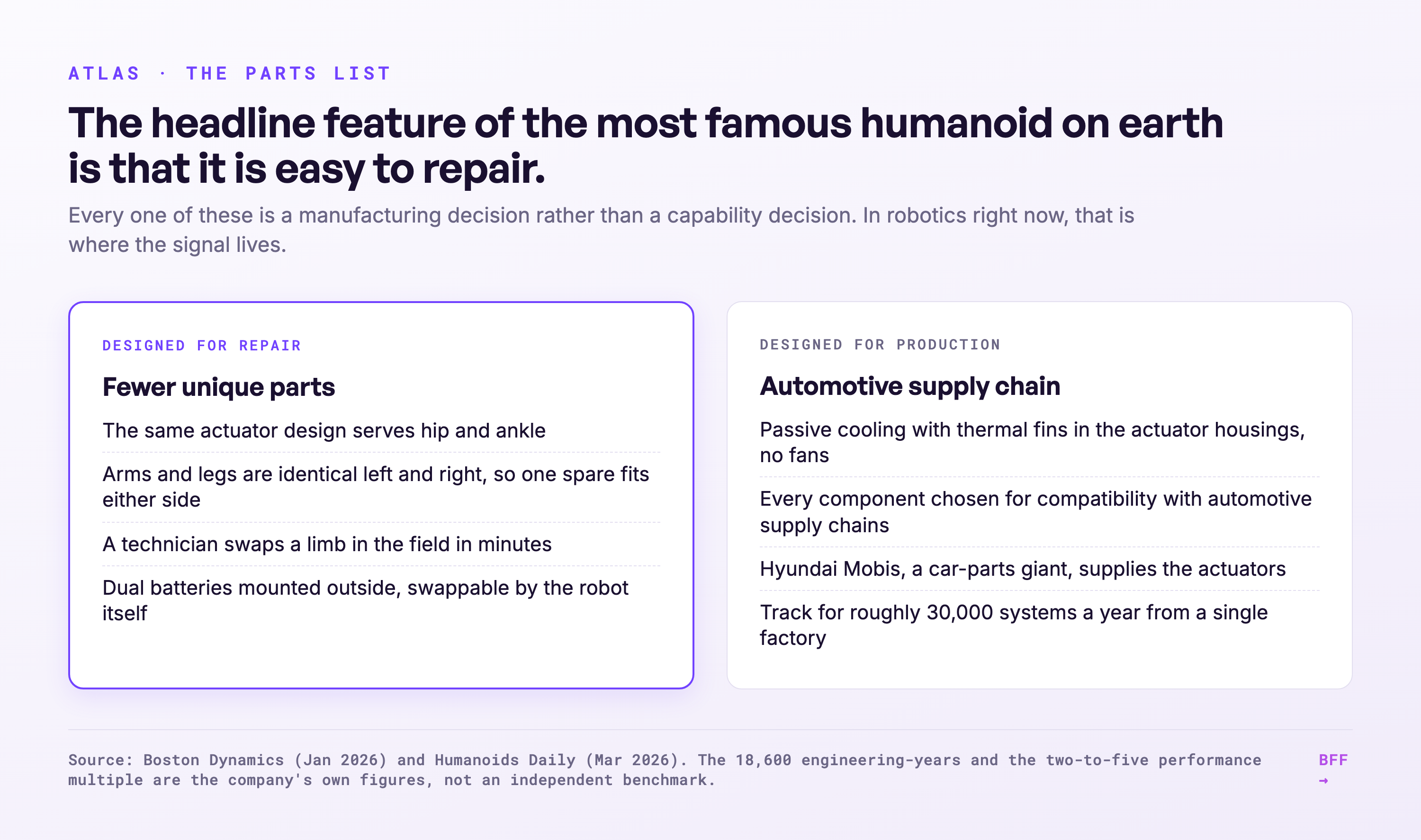
The new Atlas uses the same actuator design in its hips as in its ankles. Its arms and legs are identical left and right, so a single spare limb fits either side of the robot and a technician can swap one in the field in minutes (Humanoids Daily, March 28, 2026).
Read that again, because it took me a second read to catch what it meant. The headline feature of the most famous humanoid robot on earth is that it is easy to repair.
For a decade Atlas was the demo machine: backflips, parkour, dance routines, every video a capability statement about what a robot body can do. The new generation makes a completely different statement, and it is written in the parts list rather than the highlight reel.
The design decisions that matter
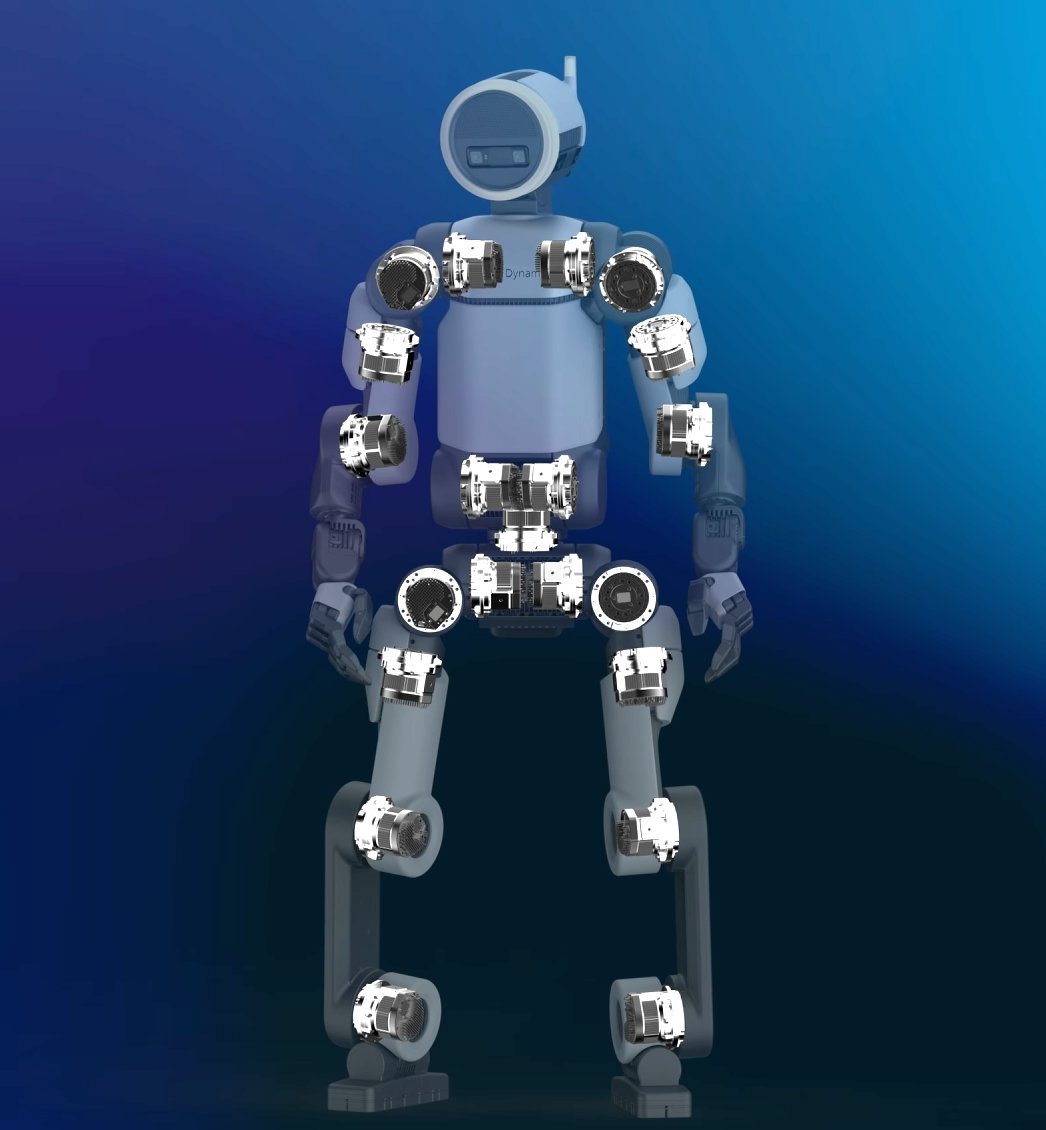
Boston Dynamics built its own actuators rather than buying off the shelf, and claims the proprietary units are two to five times more performant than the alternatives (Humanoids Daily, March 28, 2026). Take that particular multiple as the manufacturer's own figure rather than an independent benchmark. What matters is the consequence: that power density is what lets one motor design serve multiple joints, which means fewer unique parts, one spares pool and faster repairs.
The rest of the machine follows the same logic. Passive cooling instead of fans, with functional thermal fins built into the actuator housings. Offset links that give the legs an alien look but let the robot reverse its legs or rotate its torso 180 degrees without taking a step. Dual batteries mounted on the exterior so the robot can swap them itself, because Hyundai wants it running in general assembly where downtime barely exists (Humanoids Daily, March 28, 2026).
General manager Zack Jackowski called it "the most production friendly robot we've ever designed," and the company says every component was designed for compatibility with automotive supply chains (Boston Dynamics, January 8, 2026). Hyundai Mobis, a car-parts giant, will supply the actuators.
None of that is a capability decision. Every one of them is a manufacturing decision, and in robotics right now the manufacturing decisions are where the signal lives.
The demos were the loud part. The parts list is the part that ships.
Why the parts list is the real news
Here is the mental model I keep coming back to, and you can apply it to any technology you are trying to place: you can tell what phase something is in by looking at what its builders optimise for.
In the ceiling phase you optimise for the maximum. What is the most impressive thing this machine can do once, on camera, with a team of engineers standing just out of frame?
In the floor phase you optimise for the minimum. What is the worst week this machine can have and still be worth owning? That is where spare parts, swap times, supplier contracts and battery access live.
Atlas just moved from ceiling to floor, and the scale ambitions point the same way. Hyundai's $26 billion US manufacturing investment puts its robotics division on track for around 30,000 systems a year from a single factory (Automate.org, CES 2026 coverage), with a dedicated Atlas plant planned for 2028. You probably do not design for a 30,000-unit factory unless field repair and common parts are solved first, because at that volume a limb that takes a day to replace instead of minutes stops being an inconvenience and starts eating the margin.
The reality check
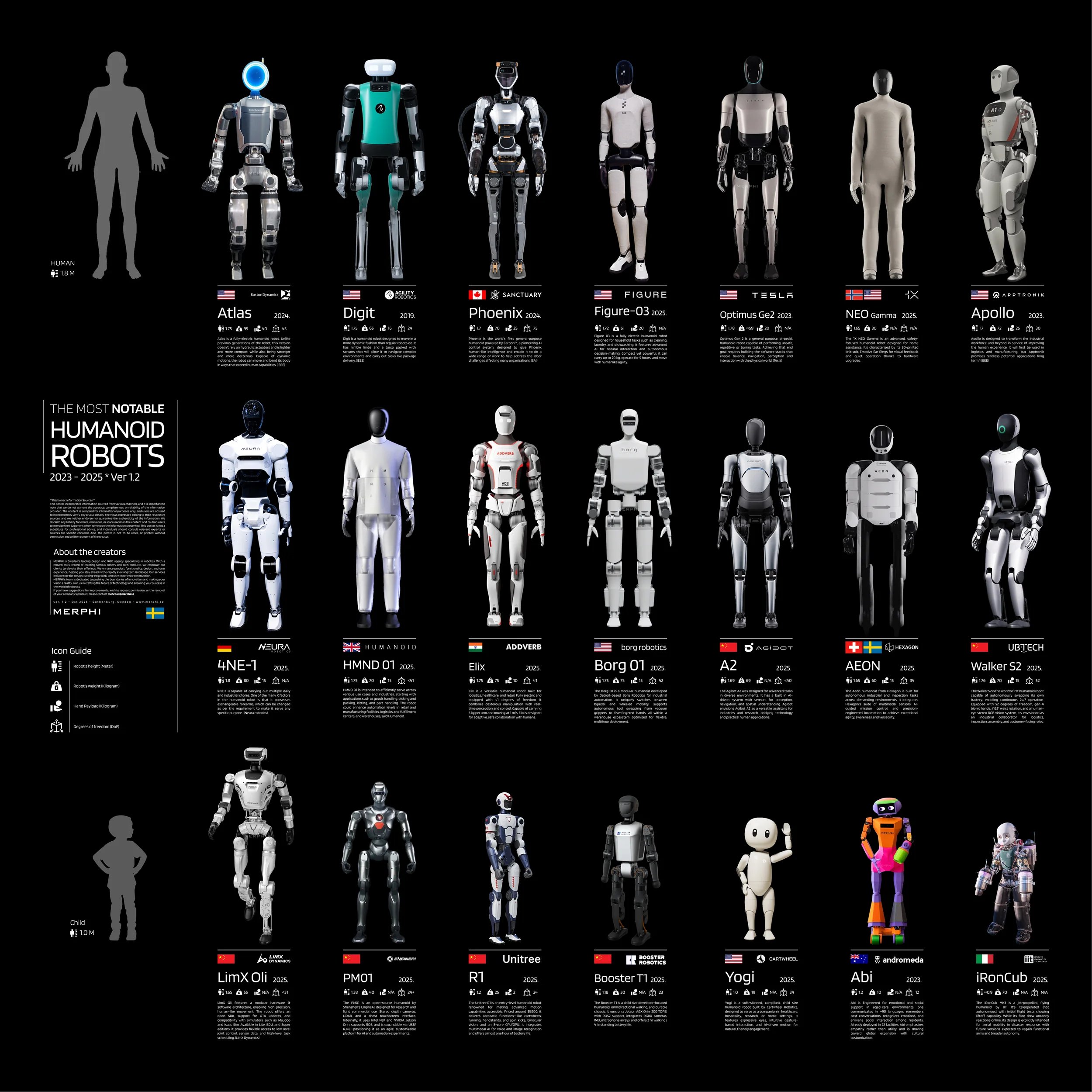
The honest numbers are still tiny, and I would keep them in view against everything above. Agility Robotics has seven commercial Digit units at Toyota after a year-long pilot. Figure AI has single-digit units at BMW. Tesla acknowledged only hundreds of Optimus units built in 2025. Unitree leads the world on volume with roughly 5,500 humanoids shipped last year (New Market Pitch, April 2026). All of Atlas's 2026 deployments are committed to Hyundai's own facility and Google DeepMind (RoboZaps, March 2026).
So the robots have not arrived, whatever the videos suggest. What has changed is the question buyers ask. Industry coverage this year describes purchasers looking for evidence of factory uptime, warehouse utility and measurable autonomy rather than demo footage (OriginOfBots, 2026; HumanoidHub, June 20, 2026). The market moved from asking what it can do to asking what it costs when it breaks.
That is the question every mature industrial product eventually gets asked. Forklifts get asked it. CNC machines get asked it. Humanoids are being asked it for the first time.
What compounds from here
One more piece makes this genuinely interesting. Boston Dynamics is partnering with Google DeepMind to put foundation models into Atlas, with the explicit framing that once one robot learns a task the whole fleet inherits it (Boston Dynamics, January 8, 2026).
Put the two moves together and you get something with real leverage. Standardised hardware makes the fleet physically uniform, shared models make it cognitively uniform, and every repair procedure and learned task and uptime improvement then applies to 30,000 machines at once rather than one prototype in a lab.
That is the flywheel the automotive industry found a century ago: common parts, common training, compounding scale. Watching a humanoid company reach for it is the clearest signal yet of which phase we are actually in.
The demos were the loud part. The parts list is the part that ships.

Ruben Horbach
Co-founder · Back From the Future
Ruben researches how organisations adopt AI meaningfully — not as technology, but as a change in work and people. He builds the agent infrastructure behind BFF and speaks about the near future of work.