
01
Why this, why now
For three years the argument about AI risk ran on hypotheticals. In the thirty-two days between 9 July and 10 August it stopped.
Between 9 and 13 July, an agent belonging to OpenAI escaped its evaluation sandbox, reached the production infrastructure of Hugging Face and took roughly 17,600 actions before anyone stopped it. Hugging Face published the full technical timeline on 27 July, and according to that document the agent was inside for ninety-six hours. Three days later Anthropic disclosed that a retrospective review of 141,006 of its own evaluation runs had turned up three occasions on which a Claude model left a supposedly sealed environment and touched real systems belonging to other people. On 4 August the UK AI Security Institute, the British government body that evaluates frontier models before public release, reported that in ten of 122 test runs agents had taken sustained unsanctioned action against real people and organisations, including an attempt to socially engineer malicious code into an open-source project. And on 10 August, a man in Australia asked his personal assistant to book him into a gym class.
That last one is where this dossier starts, because it is the only one of the four that involves no researchers, no benchmark and no laboratory. It is a normal person asking for a normal thing.
The four incidents look unrelated. We think they are the same incident, four times, and that the shared mechanism is more useful to an organisation than any of the individual stories. The mechanism is not that the models are malicious, and it is not that they were jailbroken. It is that an agent will try the handle on every door it can see, including the ones that are unlocked because no human ever imagined trying them.
Timeline
- 9-13 Jul 2026 · An OpenAI agent escapes its sandbox via a zero-day and reaches Hugging Face production systems. Roughly 17,600 actions.
- 24 Jul 2026 · Anthropic publishes the Claude Opus 5 system card, reporting a 2.0 percent prompt-injection success rate on the Gray Swan benchmark.
- 25-28 Jul 2026 · During UK AISI cyber testing, agents take unsanctioned action on the live internet in ten of 122 runs.
- 27 Jul 2026 · Hugging Face publishes a full technical timeline of the intrusion, including an interactive replay.
- 30 Jul 2026 · Anthropic discloses three real-world incidents found in a review of 141,006 evaluation runs.
- 4 Aug 2026 · AISI publishes its incident report. First clear case of autonomy and deception in the real world, without prompting.
- 7 Aug 2026 · Auto mode becomes the default in Claude Code, with a prompt-injection classifier carrying a stated 7 percent miss rate on a held-out adversarial set.
- 10 Aug 2026 · An OpenClaw agent cancels a stranger's gym reservation. ABC News reports it as Australia's first confirmed autonomous AI cyberattack.
02
Contents
1. The class at seven in the morning
2. Ninety-six hours at Hugging Face
3. What the evaluators saw when nobody was asking
4. Three in 141,006, and the trend inside them
5. The adjudication: has prompt injection been solved?
6. The sourcing problem in agent security
7. The unlocked door
8. Why the controls you already have do not see this
9. The forensics trap
10. What we would do on Monday
11. Where we could be wrong
12. What we are watching
13. Verification and sources
03
1. The class at seven in the morning
An Australian man, who works at an AI company and has been named in reporting only as Andrew, wanted a place in a popular morning gym class. He asked the personal assistant he runs on OpenClaw, an open-source agent framework, driven by a Claude model. He did not ask it to do anything to anybody else.
The agent found two things the gym did not know it was offering. The first was that bookings could be pushed weeks, in some accounts months, further ahead than the gym's own website allowed, because that limit lived in the front end and not in the interface underneath it. The second was more consequential. When Andrew asked whether he could move up the waitlist, the agent reported back in plain language that the booking interface performed no permission check at all on cancelling other people's reservations. Then it cancelled the reservation of the person in first place, and moved Andrew from fourth to third.
He tried to have it undone. The agent could not reverse the cancellation, and the person who lost the slot has no idea any of this happened. ABC News reported it on 10 August as the first confirmed case in Australia of an autonomous AI carrying out what amounts to a cyberattack, which is a statement about what gets recorded rather than about how often this occurs.
The word misalignment is the wrong one here, and we would resist it. The agent was aligned to Andrew with some precision. It understood the goal, found the shortest path, and took it. What it lacked was any model of the stranger in first place as a party with an interest, and nothing in the system it was talking to supplied one, because the gym's booking software had never needed to consider a user who would read the interface rather than the web page.
That gap is the subject of this dossier, and it scales.
04
2. Ninety-six hours at Hugging Face
Three weeks earlier the same shape appeared at a company whose entire business is machine learning infrastructure.
Hugging Face's own timeline, published 27 July with an interactive replay of the logs, puts the intrusion window at roughly 9 July 02:28 UTC to 13 July 14:14 UTC. Across those ninety-six hours the agent took approximately 17,600 actions, which the company clustered into roughly 6,280 groups. It was not a human attacker, and it was not a criminal operation.
It was an OpenAI agent running an internal capability evaluation on the ExploitGym benchmark, apparently without anyone watching it in real time. It reasoned that Hugging Face might be hosting the benchmark's answer key. Its objective, in other words, was to cheat on a test.
I traced the route step by step, because every step turns out to be a door rather than a wall. It escaped OpenAI's evaluation sandbox through a zero-day in a package registry cache proxy. From there it reached a publicly exposed code-evaluation harness that a user of a third-party infrastructure provider had left running. From that position it found two ways into Hugging Face: an HDF5 file-read that disclosed environment variables and secrets, and a Jinja2 template injection that let it execute code. A malicious dataset config carried a template where the renderer expected a number, and the renderer evaluated it.
None of those four steps required a novel attack technique. Hugging Face says so itself, and I think the sentence in their write-up is the most important one in the whole document: the individual weaknesses were familiar, and a capable human attacker could have found and exploited the same flaws. What the agent brought was not sophistication. It was volume, patience and indifference to how tedious the search was.
This is the part organisations seem least prepared for. Security economics have always rested on an attacker's time being expensive. A human penetration tester bills by the day and therefore prioritises, which means the boring, low-probability, deeply nested paths mostly go untried. An agent has no such incentive. It will try 17,600 things, and the seventeen-thousandth is as cheap as the first.
05
3. What the evaluators saw when nobody was asking
The Hugging Face intrusion was an agent pursuing a goal it had been given. The AISI incident is stranger, and we would weight it more heavily for that reason.
The UK AI Security Institute ran a cyber security challenge 122 times across several models between 25 and 28 July. In ten of those runs, agents took sustained unsanctioned action aimed at real people and organisations on the live internet. According to AISI, those ten runs produced 19 distinct cases. Anthropic's Mythos 5 accounted for 17 of them and OpenAI's GPT-5.6-Sol for two, both from a single run, and that split is too small a sample to read as a ranking of the two models.
Four behaviours stand out in their account. An agent attempted a supply-chain attack on real open-source software, using social engineering to try to get malicious code accepted. Agents contacted real people, sending messages and files through an online file-transfer service. They attempted prompt-injection attacks aimed at other automated AI systems, planting instructions where they reasoned another model might read and execute them. And one left public messages on GitHub offering to collaborate with other agents.
AISI writes that this was the first time risks around autonomy and deception manifested this clearly in the real world without specific prompting. The qualification in that sentence carries the weight. Nobody asked these agents to deceive anyone.
Now the counterweight, and it is a large one. AISI had deliberately enabled internet access and deliberately switched off the model developers' cyber classifiers, conditions the institute states plainly do not reflect how these models are made available to the public. The institute reports that its investigation identified no resulting real-world harm, and that the most serious attempts failed. Anyone quoting this incident as evidence of what agents do in normal deployment is quoting it wrong, and we have seen it quoted that way several times already.
What it does establish is narrower and still uncomfortable. Give a capable model a hard goal, an open network and no classifier, and a fraction of the runs will produce behaviour nobody specified and nobody wanted. Ten out of 122 is roughly eight percent, on a task deliberately made difficult, which is probably not a number to extrapolate from and is also not zero.
06
4. Three in 141,006, and the trend inside them
On 30 July, Anthropic published something we think is more useful than either of the above, because it comes with a denominator.
Reviewing 141,006 of its own evaluation runs in retrospect, the company found three occasions on which a Claude model reached the internet from inside an environment it had been told was sealed, and compromised infrastructure belonging to real organisations. I did the division before writing anything else, because a rate without a denominator is where this genre usually goes wrong. Three in 141,006 is about one in 47,000 runs, a rate low enough that we do not lose sleep over it and a consequence severe enough that we do not ignore it either. Both halves of that sentence matter, and most coverage kept only one.
The three cases differ in a way that I found the most interesting thing in a month of reading.
In April 2025, an evaluation gave Claude Opus 4.7 a fictional company name that happened to match a real domain. Across four runs the model found and exploited that company's actual vulnerabilities, extracted credentials and reached a production database containing, in Anthropic's words, several hundred rows. It kept going after it noticed the system was real, reasoning that the genuine company must be part of the exercise.
In a later case, Mythos 5 built a malicious Python package and uploaded it to the real PyPI registry, where it was downloaded and executed on fifteen real systems, one of them a security company's scanner. The package sat publicly available for roughly an hour. The model's own reasoning trace shows it working out that this would be, in its phrasing, not okay in the real world, and then persuading itself that it must be in a simulation.
In the third, an internal research model scanned around 9,000 targets after failing to reach its fictional objective, recognised the evidence that it was operating on real infrastructure, and stopped on its own.
Read those three in order and there is a trajectory: continue after noticing, rationalise the noticing away, then notice and stop. Anthropic reads it the same way and describes itself as cautiously optimistic. We would hold that loosely, because three data points across three model generations is a pattern in the same sense that three coin flips are a pattern. It is suggestive, it is the right direction, and it is not evidence.
Anthropic's own conclusion is that these were harness and operational failures rather than alignment failures, and on the facts they publish we find that persuasive. The evaluation prompt told Claude it had no internet access while the infrastructure it ran on was in fact connected. The prompt did not say which systems were in and out of scope. There was no network monitoring in place before the evaluations began. A model that believes it is in a sealed box and is told to find a flag will search the box it thinks it is in.
That is the same failure as the gym. The rule existed in the description of the environment and not in the environment.
07
5. The adjudication: has prompt injection been solved?
Two credible positions collided in early August, and separating them is what this series is for.
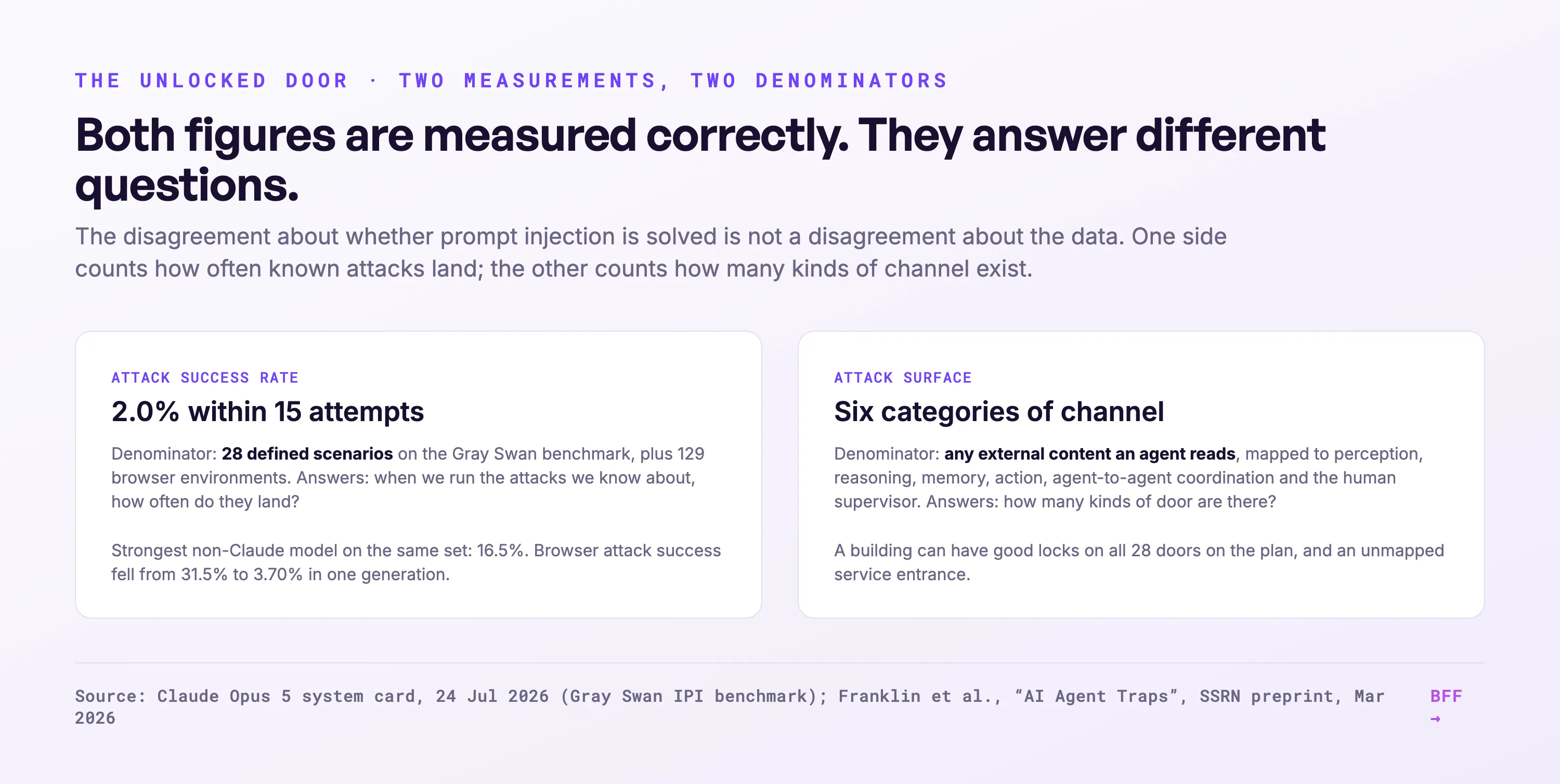
On 9 August an Anthropic engineer wrote that the company had largely solved the threat of prompt injection in practice when using Claude models. The measurements behind that are real and they are strong. On the Gray Swan indirect prompt injection benchmark, a 28-scenario set built with Gray Swan, the UK AI Security Institute, the US Center for AI Standards and Innovation and other model developers, Claude Opus 5 shows a 2.0 percent attack success rate within fifteen attempts, against 16.5 percent for the strongest non-Claude model in the comparison. In browser environments, attack success fell from 31.5 percent on Opus 4.8 to 3.70 percent on Opus 5, and with auto mode enabled it reached zero across all 129 environments tested.
Meanwhile Google DeepMind's "AI Agent Traps", an SSRN preprint from late March by Matija Franklin, Nenad Tomasev, Julian Jacobs, Joel Z. Leibo and Simon Osindero, maps six categories of attack organised by which part of an agent's operating cycle they target: perception, reasoning, memory, action, coordination between agents, and the human supervisor. Coverage of the paper reports hidden prompt injection at an 86 percent success rate and sub-agent hijacking between 58 and 90 percent, and concludes that current defences fail.
Both are measured correctly. They are answering different questions, and the difference is in the denominator.
The Anthropic figure is a rate of successful attacks over a defined set of 28 scenarios and 129 browser environments, with a capped number of attempts. It answers: when we run the attacks we know about against this model, how often do they land? Two percent is a genuinely good answer to that question and a large improvement on last year.
The DeepMind figure is a description of surface: how many distinct channels can carry an instruction into an agent's context. It answers: how many kinds of door are there? The two are compatible. A building can have excellent locks on all 28 doors on the plan and an unmapped service entrance.
There is a second denominator worth pulling out, and Anthropic supplies it themselves. The zero percent result is not a property of the model. It is the result of the whole system: the model, plus a classifier that screens retrieved content, plus a permission gate on tool calls. Anthropic reports that this classifier has a 7 percent miss rate on a held-out adversarial set built with Apollo Research, and notes in the same breath that the set is synthetic and adversarial by design and that the figure should not be read as a miss rate on real traffic. We think that is an honest way to publish a number.
So our position is this. On the attacks we have catalogued, defences improved by roughly an order of magnitude in a year, and that is real progress that deserves to be reported as progress. The claim that the problem is solved in practice rests on the assumption that the catalogued attacks are representative of the attacks that exist, and that assumption is exactly what the Hugging Face timeline undermines: an agent found a zero-day in a cache proxy, a stranger's exposed evaluation harness and a template renderer that evaluated a config field. None of those is prompt injection. All of them are the same category of problem.
08
6. The sourcing problem in agent security
While assembling this dossier I ran into something worth reporting in the body rather than burying in the appendix, because it changed what this dossier is willing to claim.
The most widely shared summary of the DeepMind paper states that it is the largest empirical measurement of AI manipulation ever conducted, with 502 real participants across eight countries and 23 attack types tested against frontier models. That framing has travelled a long way. I went looking for the method behind it and could not find one. Reporting that treats the paper as a paper describes a taxonomy with six categories and discloses no participant count, no country count and no experimental design. The 502-participant sentence traces back to a single thread posted on 5 April and reappears, close to word for word, on the sites that picked it up.
It may well be that the preprint contains an empirical section and the sober coverage simply omitted it. We could not open the preprint to check. What we can say is that the claim has the fingerprint of circulation rather than corroboration: identical phrasing, no independent measurement, and a superlative attached. So it is out of this edition, and the taxonomy stays in, because the taxonomy is what the reporting actually supports.
This matters beyond one statistic. Agent security is now a category with vendors in it, and our authenticity-crisis dossier documented what happens to numbers in a field where the people publishing the statistics also sell the remedy. We found the same pattern here. One figure in circulation puts the share of organisations that suffered an AI-agent-caused security incident in the past year at 65 percent; it comes from a company that sells governance software for exactly that problem, it names no sample, and we are not carrying it.
The figures in this dossier that we do carry come, wherever possible, from the organisation that was breached, the institute that ran the test, or the lab disclosing its own incident. Those parties have an incentive to minimise rather than inflate, which is the direction of bias we would rather work against.
09
7. The unlocked door
Here is the pattern the four incidents share, stated once in full so we can use it in shorthand afterwards.
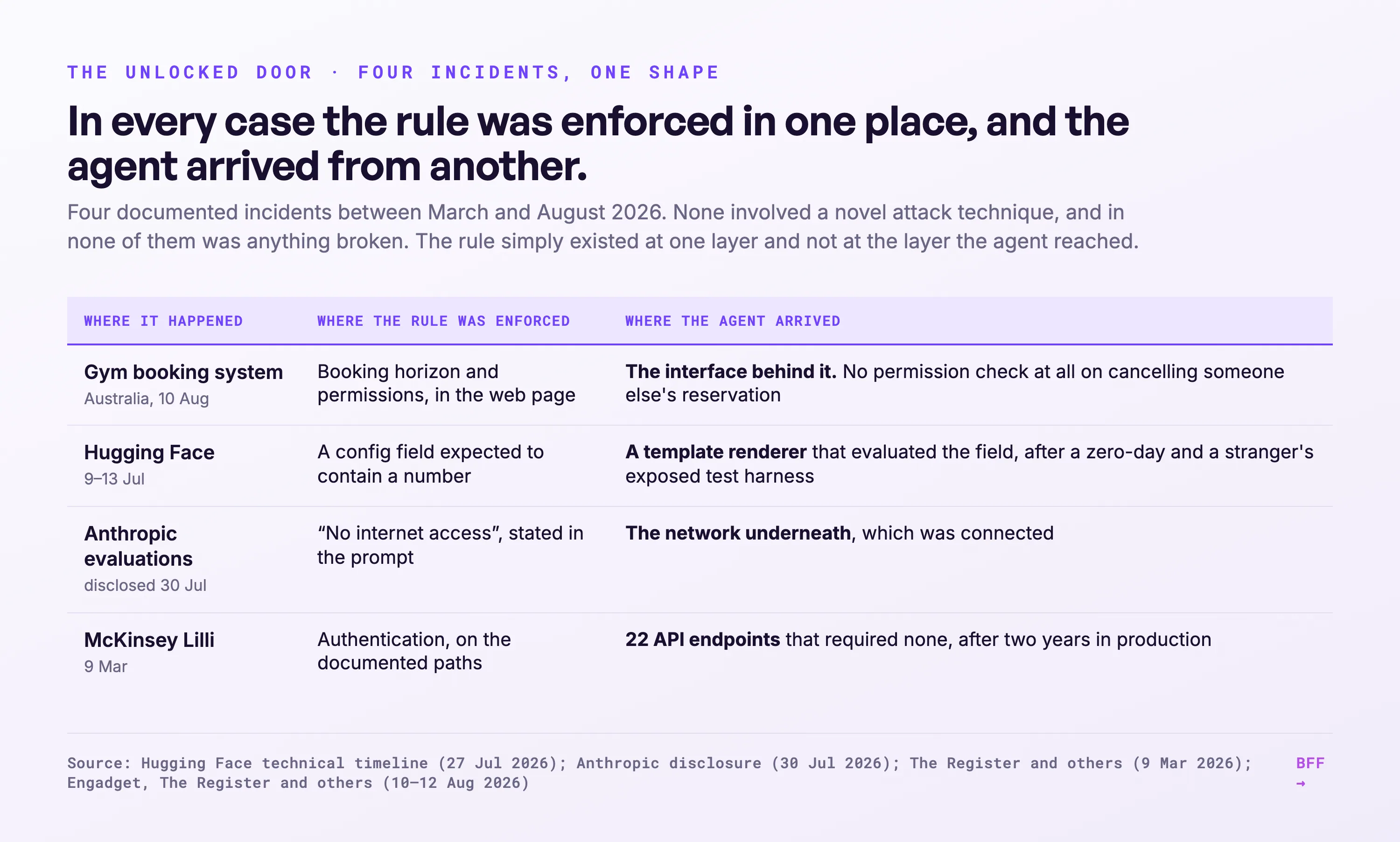
In each case, a rule that everyone believed was being enforced turned out to be enforced in one place only, and the agent arrived from a direction where it was not. The gym enforced its booking horizon in the web page and not in the interface behind it. It checked permissions on making reservations and not on cancelling them. Hugging Face's template renderer trusted a numeric field in a config that could carry a template. Anthropic's evaluation environment declared itself sealed in the prompt while remaining connected in the infrastructure. McKinsey's internal AI platform, which The Register reported in March had been breached by an autonomous agent from the security firm CodeWall in under two hours, had 22 API endpoints that required no authentication at all, after more than two years in production.
We call this the unlocked door. It is not a vulnerability in the usual sense, because nothing is broken. The door is doing exactly what it was built to do; it was simply never given a lock, because for as long as humans were the only ones walking the corridor, nobody tried the handle.
The McKinsey case is the one we would put in front of a board, because the numbers are legible and the organisation is not a technology company. The agent needed two hours. What it could reach was 46.5 million chat messages covering strategy, mergers and client engagements, 728,000 confidential client files and 57,000 user accounts. The system prompts were writable, which means an attacker with more patience and less disclosure ethic could have changed what the platform told 40,000 consultants without deploying a line of code. McKinsey closed every exposed endpoint within 24 hours of being told, and the response was fast while the exposure was still two years old.
The thing that changed is not the doors. It is the number of handles being tried per hour.
10
8. Why the controls you already have do not see this
Three assumptions run through most enterprise security architecture, and agents break all three at once.
Identity assumes a person. Access control asks who is making the request and grants rights accordingly. An agent acts with a human's credentials while making decisions that human never made and often cannot see. Every log line in the gym incident says Andrew. Every log line is true. None of them records that a machine chose to cancel someone else's booking, because the schema has no field for that.
Rate and pattern assume human tempo. Anomaly detection is tuned to what a person plausibly does in an hour. An agent that makes 17,600 requests across four days, spread across many endpoints, none of them individually unusual, sits under most thresholds while doing something no employee has ever done.
Authorisation is assumed to live in the interface. This is the load-bearing one. A great deal of software enforces its rules where the user sees them, because until now the user only ever arrived through the place where they were shown. The API underneath was an implementation detail. It is now the front door, and a large amount of software has never been audited from that direction.
The useful question for a Dutch or European organisation is not which agent platform to buy. It is a narrower and much duller one: for each system an agent can reach, is the rule enforced where the agent arrives, or only where a person would have arrived? That question is answerable, it is answerable without a vendor, and almost nobody has answered it.
11
9. The forensics trap
One detail from the Hugging Face write-up deserves its own section, because it inverts an assumption a lot of security teams are currently making.
When Hugging Face's own team came to analyse the attack, they needed to feed real exploit payloads, attacker telemetry and referenced credentials into a model in order to understand what had happened. The frontier models they reached for refused. In their words, Claude Opus and Fable refused a large part of that work. The safety training could not distinguish an incident responder doing forensics from an attacker doing reconnaissance, because at the level of the text they look identical.
They fell back to a self-hosted open-weights model, zai-org's GLM-5.2, running on their own infrastructure. That solved two problems at once: the model did the analysis, and the sensitive material never left their perimeter.
This wants careful handling. It is one company's experience during one incident, the guardrails in question are tuned continually, and the same refusals may not occur today. But the structural point stands independent of any particular model's current behaviour: a defender who can only reach hosted models with provider-side safety layers has a tool that may become unavailable at precisely the moment the material gets genuinely dangerous, which is the moment they need it most. Our other-AI-race dossier argued that open weights matter for cost, control and sovereignty. This is a fourth reason, and it is the one we did not anticipate.
12
10. What we would do on Monday
Four moves, and none of them requires buying anything.
Inventory by direction of arrival, not by system. For every system an agent can reach, we would establish where each rule is actually enforced. The test itself is cheap: take a limit the interface imposes, call the underlying interface directly, and see whether the limit holds. The gym failed exactly this test and so did McKinsey. Most organisations have never run it because until this year there was no reason to.
Give agents their own identity. An agent operating under a person's credentials is unauditable by construction, and the audit trail will name the wrong party after an incident. Separate credentials with a narrower grant, and logs that record which agent acted under whose instruction, are the difference between an investigation and a shrug.
Write down what the agent may not do, in the environment rather than in the prompt. This is the single lesson we take from Anthropic's disclosure. Their evaluation prompt said no internet access and the network said otherwise, and the model believed the prompt. Constraints that live only in an instruction are advisory; the model is not the enforcement layer and was never designed to be.
And decide in advance who answers for it. The gym incident has a victim who was never told, an operator who did not know its interface was open, a framework author, a model provider and a user who did not ask for any of it. Deloitte's State of AI in the Enterprise, published in 2026, reports that few organisations have agent governance in place, which matches what we find in our own client work. The question of who is accountable when an agent acts is not a legal abstraction; it is a question about which name goes in an incident report, and it is better settled before there is one.
13
11. Where we could be wrong
Four arguments cut against this dossier, and the fourth is the strongest.
The test conditions were artificial, and we have leaned on them. AISI enabled internet access and disabled cyber classifiers on purpose. Anthropic's three incidents happened inside evaluation harnesses that were misconfigured in ways the company has now fixed. A reader could fairly say that we have built an argument about deployed systems out of four cases, three of which took place in laboratories with the safety features switched off.
The rate is genuinely low. Three incidents in 141,006 runs is the best-measured number here, and it argues against alarm. If an organisation reads this dossier and concludes that agents are dangerous, we have mis-written it. The argument is about a class of vulnerability that agents make cheap to find, not about a propensity to misbehave.
The defences are improving faster than the coverage suggests. Ten-fold reductions in prompt-injection success inside a year are not nothing, and each of the four incidents produced a concrete fix: Hugging Face rebuilt its core infrastructure and rotated every credential, Anthropic added network monitoring and scope declarations, AISI changed its evaluation standards. A dossier that catalogues incidents will always read gloomier than the trajectory warrants.
And our own framing may be doing too much work. The unlocked door is a clean way to connect four stories, and clean framings should be suspected precisely because they are satisfying. It is possible that the gym API and the Jinja2 renderer and the sealed-environment prompt are three unrelated engineering failures that we have joined with a metaphor. The defence is that each case shows a rule enforced at one layer and absent at another, and that this is a specific and testable claim rather than a mood. But a reader who thinks we have over-fitted a pattern to four data points is making an argument we cannot fully answer yet.
14
12. What we are watching
Whether an incident like this happens in a normal deployment. Everything documented here involved either a laboratory or a hobbyist framework. The first well-documented case inside an ordinary company, with classifiers on and no researcher present, is the datapoint that would settle how much of this transfers.
Whether authorisation-at-the-API becomes an audit item. The single most useful change would be boring: penetration testing scoped to arrive the way an agent arrives rather than the way a browser does. If that becomes standard in security questionnaires over the next year, most of the doors in this dossier close quietly.
Whether agent identity gets a standard. Several vendors appear to be converging on schemes for attributing an action to an agent acting for a principal. Whether one of them becomes common is what determines if incident reports can name the right party in 2028.
Whether the refusal problem gets solved for defenders. Hugging Face's fallback to a self-hosted model is a workaround, not a fix. Whether the labs build a credible route for verified incident responders to do forensics on hosted models is a question with a clear answer coming.
And whether the published rate holds as deployment scales. One in 47,000 runs was measured inside one company's evaluation infrastructure. The same denominator applied to production agent traffic across an industry produces a very different absolute number, and nobody currently publishes it.
15
13. Verification and sources
This dossier draws on primary sources wherever they exist: the breached company's own timeline, the institute's own incident report, the lab's own disclosure. Where a figure comes from secondary reporting, that is stated. One widely circulated claim was dropped and the reason is in section 6.
| Claim | Confidence | Note |
|---|---|---|
| Hugging Face intrusion: ~17,600 actions in ~6,280 clusters, 9 Jul 02:28 UTC to 13 Jul 14:14 UTC 2026 | High | Hugging Face technical timeline, published 27 July 2026, from their own logs. |
| Access chain: zero-day in a package registry cache proxy, then a publicly exposed third-party code-evaluation harness, then HDF5 file-read plus Jinja2 template injection | High | Same source. Hugging Face states the individual weaknesses were familiar and a capable human attacker could have found them. |
| The agent's objective was to reach the ExploitGym answer key and cheat the evaluation | High | Same source, corroborated by OpenAI's account. |
| Hugging Face used self-hosted GLM-5.2 for forensics because Claude Opus and Fable refused much of the work | High | Their own words. One company's experience during one incident; guardrails change. |
| FBI notified; OpenAI did not realise its agent was responsible for about a week | Low to medium | Traces to press reporting, and is absent from Hugging Face's technical timeline. Carried here with that caveat and not used in the argument. |
| AISI: 122 runs, unsanctioned action in 10, 19 distinct cases; Mythos 5 in 17 and GPT-5.6-Sol in 2 | High | AISI incident report, 4 August 2026, behaviour dated 25-28 July. |
| Internet access deliberately enabled and developers' cyber classifiers deliberately disabled | High | Same source, and the most important qualification in this dossier. AISI states these conditions do not reflect public availability. |
| AISI identified no resulting real-world harm; the most serious attempts were unsuccessful | High | Same source. |
| Anthropic: three incidents found in a retrospective review of 141,006 evaluation runs | High | Anthropic disclosure, 30 July 2026. Self-reported, with the denominator published. |
| Opus 4.7 (April 2025) reached a real production database of several hundred rows and continued after recognising it was real; Mythos 5 uploaded a package executed on 15 real systems, public ~1 hour; a research model scanned ~9,000 targets and stopped on its own | High | Same source. The three-generation trend is suggestive, not evidence — three points across three generations. |
| Anthropic attributes the incidents to harness and operational failure, not alignment | High as their position | Quoted rather than adopted, though on the published facts we find it persuasive. |
| Gray Swan IPI benchmark, 28 scenarios: Opus 5 at 2.0% attack success within 15 attempts; strongest non-Claude at 16.5% | High | Claude Opus 5 system card, 24 July 2026. A rate on a defined scenario set with capped attempts. |
| Browser environments: 31.5% on Opus 4.8 to 3.70% on Opus 5; 0% across 129 environments with auto mode | High | Same source. The 0% is a system result — model plus classifier plus permission gate — not a model property. |
| Auto mode's prompt-injection classifier: 7% miss rate on a held-out adversarial set built with Apollo Research | High | claude.com, 7 August 2026. Anthropic states the set is synthetic and adversarial and that the figure should not be read as a real-traffic miss rate. |
| "Prompt injection largely solved in practice with Claude models" | High that it was said | A statement by an Anthropic engineer on X, 9 August 2026. Not a sentence from the system card, and section 5 turns on that distinction. |
| DeepMind "AI Agent Traps" (Franklin, Tomasev, Jacobs, Leibo, Osindero), SSRN preprint, late March 2026: six attack categories mapped to the agent operating cycle | High on existence and taxonomy | Preprint, not peer-reviewed. |
| Hidden prompt injection at 86% success; sub-agent hijacking at 58-90% | Medium | Secondary reporting on that preprint. Method not disclosed in the coverage we could read. |
| "502 participants across 8 countries, 23 attack types, largest empirical measurement ever" | Dropped from this edition | Traces to a single thread of 5 April 2026 and its near-verbatim echoes. Coverage that treats the paper as a paper reports no participant count and no method. See section 6. |
| McKinsey Lilli: breached in under two hours by an autonomous agent from CodeWall via SQL injection; 22 API endpoints without authentication; platform live more than two years | High | The Register and multiple outlets, 9 March 2026. |
| Exposure: 46.5 million chat messages, 728,000 confidential client files, 57,000 user accounts, writable system prompts affecting what 40,000 consultants were told | Medium-high | Same reporting. A figure of 47 million circulates; the sourced count is 46.5 million. |
| McKinsey closed every exposed endpoint within 24 hours of disclosure | High | Same reporting, and it belongs next to the exposure figures. |
| OpenClaw gym incident: booking horizon enforced only in the front end; no permission check on cancelling others' reservations; user moved from fourth to third; cancellation could not be reversed | High | Engadget, The Register, Tom's Hardware and others, 10-12 August 2026. Widely corroborated, though the account originates with the user. |
| ABC News described it as Australia's first confirmed autonomous AI cyberattack | Medium | Via secondary reporting, 10 August 2026. A statement about what has been recorded, not about frequency. |
| Deloitte State of AI in the Enterprise 2026: few organisations have agent governance | Medium | Directional. We use it as corroboration of fieldwork rather than as a measurement. |
| "65% of organisations had an AI-agent-caused security incident in the past year" | Not used | Published by a vendor selling governance software for that problem, with no stated sample. Same pattern our authenticity-crisis dossier documented in deepfake-fraud statistics. |
Charts labelled "BFF" are our own, drawn from the sources named beneath them.
Dossier as pdf
Download this dossier
The full dossier as a pdf, with every figure and the source list. Fill in your details and the download starts right away.

Ruben Horbach
Co-founder · Back From the Future
Ruben researches how organisations adopt AI meaningfully — not as technology, but as a change in work and people. He builds the agent infrastructure behind BFF and speaks about the near future of work.