

In short
- Ultrasound-based brain interfaces can read neural activity without surgery or implants.
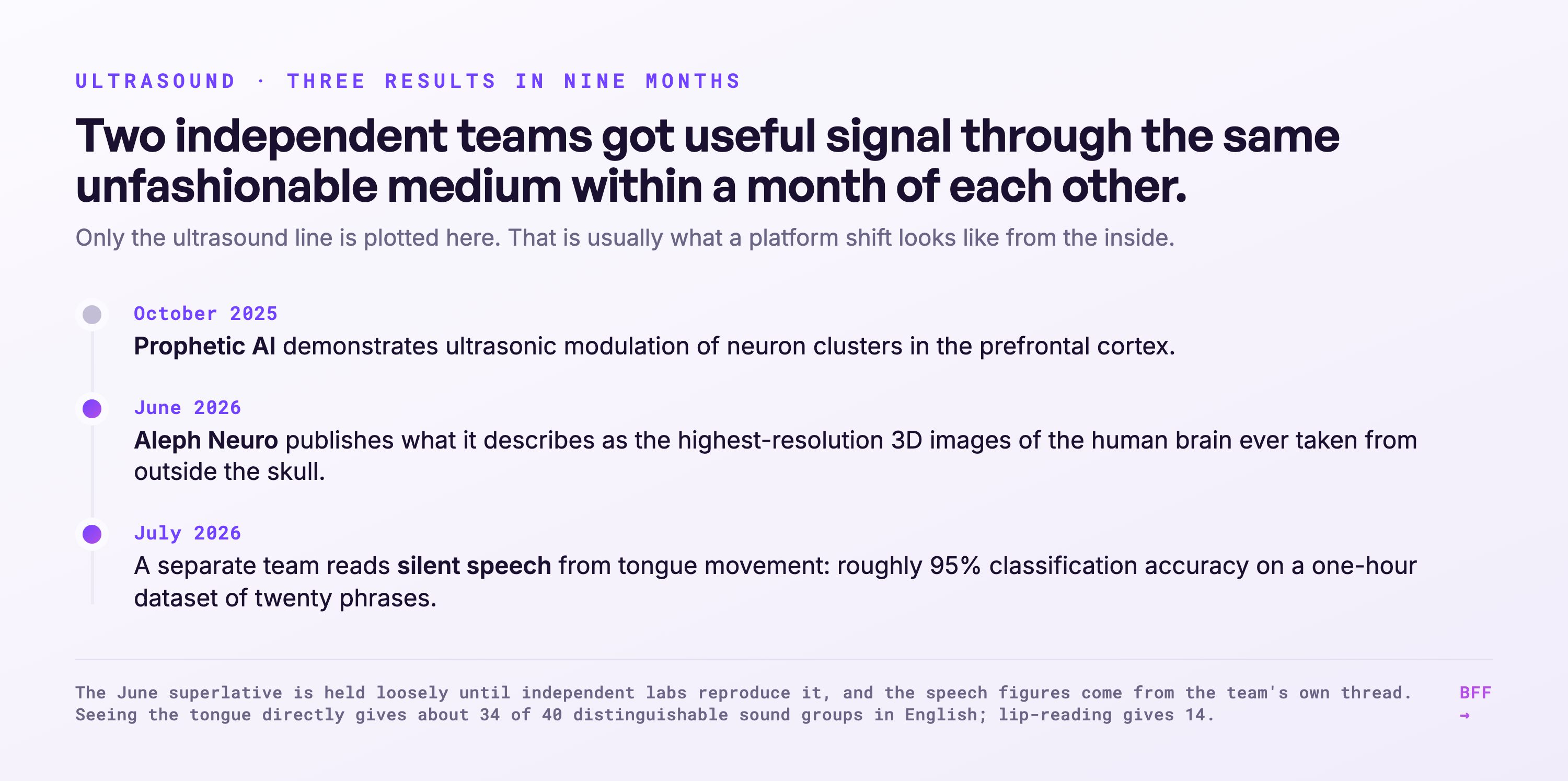
- Aleph Neuro claimed the highest-resolution 3D brain images from outside the skull in June 2026.
- A separate team hit ~95% accuracy on silent-speech decoding via ultrasound in July 2026.
- Non-invasive methods reaching even 70% of implant performance would flip the addressable market from thousands to everyone.
- The '$500M revenue' imaging anecdote is flagged as unverified and directional only.
A post I wrote last week about Aleph Neuro travelled further than most of what I publish, and I think I know why. The idea underneath it is bigger than one company: the most funded, most visible player in a frontier field is often not the one that ships the thing you end up using. This piece is the longer version of that argument, with the mechanism, the evidence from my own archive, and the one claim I could not fully verify.
The physics first
Aleph Neuro is reading neural activity with focused ultrasound. No implant, no surgery, no drilling. The mechanism is elegant: when neurons fire, blood flow in that region shifts within seconds, and shifting blood flow changes how ultrasound waves scatter as they pass through tissue. Send focused sound through the skull, read the echo, and you get a map of which regions are active. In June 2026, Aleph published what it described as the highest-resolution 3D images of the human brain ever taken from outside the skull.
I'd hold the superlative loosely until independent labs reproduce it. But the direction is hard to argue with, because this is the second ultrasound result in my archive within a month.
In early July 2026, a separate team demoed silent speech through ultrasound: a sensor under the jaw captures tongue movements, and a model predicts the words you're mouthing without you making a sound. Their numbers, from their own thread: a one-hour dataset of 20 phrases yielded roughly 95% classification accuracy, and after a month of data collection the model was approaching existing silent-speech modalities. The reason ultrasound works so well here is anatomical. Seeing the tongue directly gives you about 34 distinguishable sound groups out of 40 in English; lip-reading gives you only 14. The tongue carries most of the signal, and ultrasound is the only non-invasive way to watch it.
Two different teams, two different problems, same physics. That's usually what a platform shift looks like from the inside.
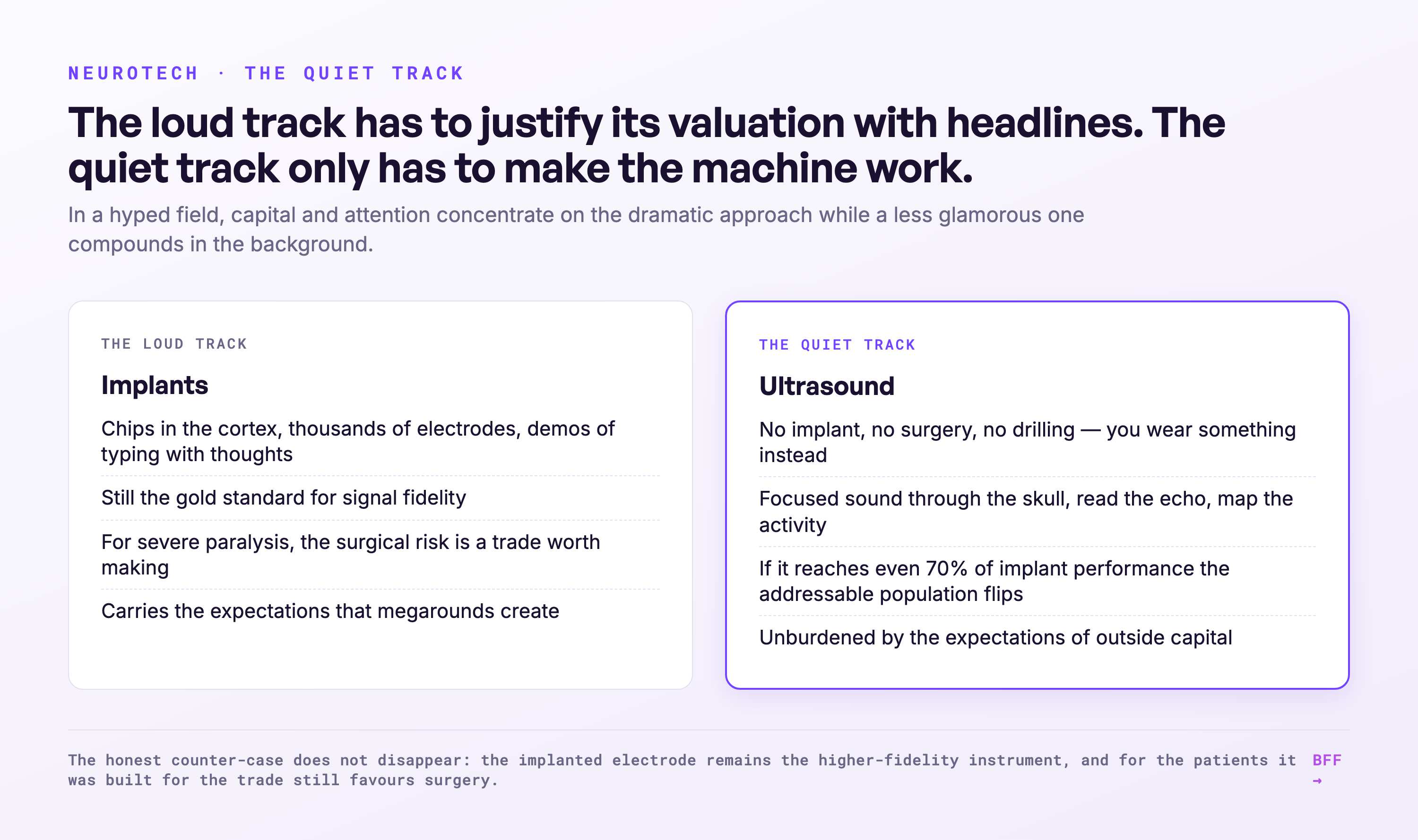
The loud track has to justify its valuation with headlines. The quiet track only has to make the machine work.
Where the attention went instead
Most neurotech coverage over the past few years has gone to implants. Chips in the cortex, thousands of electrodes, demos of people typing with their thoughts. I've shared plenty of those myself, and the work is genuinely impressive. The implanted electrode remains the gold standard for signal fidelity, and for people with severe paralysis the surgical risk is a trade worth making. That's the honest counter-case, and it doesn't disappear.
But the trade changes completely for everyone else. An implant asks you to accept open-brain surgery, a foreign object in your cortex, and a hardware upgrade path that involves a scalpel. Ultrasound asks you to wear something. If non-invasive methods get to even 70% of implant performance, the addressable population flips from thousands of patients to potentially everyone, and I think we're watching that convergence happen quarter by quarter. Prophetic AI was already demonstrating ultrasonic modulation of neuron clusters in the prefrontal cortex back in October 2025. As one post in my archive put it at the time: it feels like nothing happens for years, and then hundreds of breakthroughs show up at once.
The Quiet Track
I've started calling this pattern the Quiet Track: in a hyped field, capital and attention concentrate on the dramatic approach, while a less glamorous approach compounds in the background, unburdened by the expectations that megarounds create. The loud track has to justify its valuation with headlines. The quiet track only has to make the machine work.
In my original post I cited a parallel from medical imaging: a company that reportedly built radiation-free preventive scanning to around $500 million in revenue with roughly 200 employees and no venture capital. I went looking for the primary source on that claim while writing this piece and could not verify it to my own standard, so treat those specific figures as directional rather than confirmed. The pattern the anecdote points at, though, shows up repeatedly: MRI-based preventive scanning grew into a real market while the flashier diagnostic bets absorbed the press cycles. If someone in the comments has the primary source, I'd genuinely like to see it.
What I'm watching
The Quiet Track gives you a useful question for any frontier field you follow, whether it's neurotech, robotics, or energy: where is the approach that gets no keynote slot but keeps quietly improving its numbers? In brain interfaces, my current answer is ultrasound. The resolution results from June, the silent-speech results from July, and the modulation work from late 2025 sit on a curve that implants will find hard to match on accessibility, whatever they win on fidelity.
I could be wrong about the timeline. Skull attenuation is a real physics constraint, and lab demos have a long way to travel before they become products you'd wear to a meeting. But when two independent teams get useful signal through the same unfashionable medium within a month of each other, the quiet track has stopped being quiet. That's usually the moment worth marking.

Ruben Horbach
Co-founder · Back From the Future
Ruben researches how organisations adopt AI meaningfully — not as technology, but as a change in work and people. He builds the agent infrastructure behind BFF and speaks about the near future of work.